
The honest answer right now is that confirmed ownership details for Nathan's Patio Bar & Grill are not publicly resolved in any single, universally searchable database because multiple businesses trade under that name across different states. To get the definitive legal owner, you need the venue's exact city and state, then run a direct lookup through that state's Secretary of State business registry. That process takes about five minutes and gives you the registered agent, entity type, and filing history, which is the most reliable answer you can get. Everything below walks you through exactly how to do that, plus what to expect when you visit, how to check events, and how to avoid mixing this place up with similarly named patios.
Who Owns Nathan's Patio Bar & Grill? Owner, Contact & Events

Kira Carver
7 Aug 2026
Quick ownership summary: how to confirm who legally owns it right now
Because at least a handful of bars and grills have operated under the Nathan's Patio name in different parts of North America, there is no single ownership answer that applies everywhere. What you need is the street-level identity of the specific location you're researching. Once you have that, the fastest path to a confirmed owner is the blank" rel="noopener noreferrer">state Secretary of State (SOS) business search portal. To directly answer who owns the patio restaurant, run the SOS business search for the venue's exact city and address. Search the exact legal entity name, pull the filing record, and look at three fields: the registered agent name, the organizer or incorporator name, and any manager or member entries on LLC filings. Those fields give you the legal owner on record, with a dated document you can screenshot or save as a PDF.
If the SOS record shows a generic registered agent service (like a law firm or incorporation service), that doesn't mean you've hit a wall. Go one level deeper: check the county clerk's DBA (doing-business-as) or assumed name filings for the county where the restaurant sits. DBA filings almost always name the real person or entity behind the trade name. Between the SOS filing and the DBA record, you'll have a confirmed owner in most cases.
Official contact and visitor details you should verify before you go
Because this guide covers the name rather than a single confirmed address, the specific contact details below represent the information categories you need to confirm directly with the venue before visiting. Restaurant hours, phone numbers, and websites change, and a quick call or Google listing check takes 30 seconds and saves a wasted trip.
| Detail | Where to Confirm It | Why It Matters |
|---|---|---|
| Street address and city | Google Maps listing or the venue's own website | Confirms you have the right location, not a similarly named bar |
| Phone number | Google Business Profile or Facebook page | For reservations, event inquiries, and same-day hours |
| Official website | Google search for the exact venue name plus city | Check for current menus, specials, and booking forms |
| Social media accounts | Facebook, Instagram — search name plus city | Live updates on events, closures, and promos |
| Hours of operation | Call or check Google listing marked 'updated by owner' | Hours shift seasonally, especially for outdoor patio venues |
| Dress code | Facebook page or call ahead | Most patio bars are casual, but some enforce dress standards for evening events |
For patio venues specifically, hours matter more than they do at indoor restaurants. A lot of patio bars shorten or suspend outdoor service on cold or rainy days, and that change rarely shows up on third-party platforms in real time. Calling ahead is always the right move, especially between October and April or during unpredictable summer storm seasons.
What the patio experience is actually like: seating, amenities, and accessibility
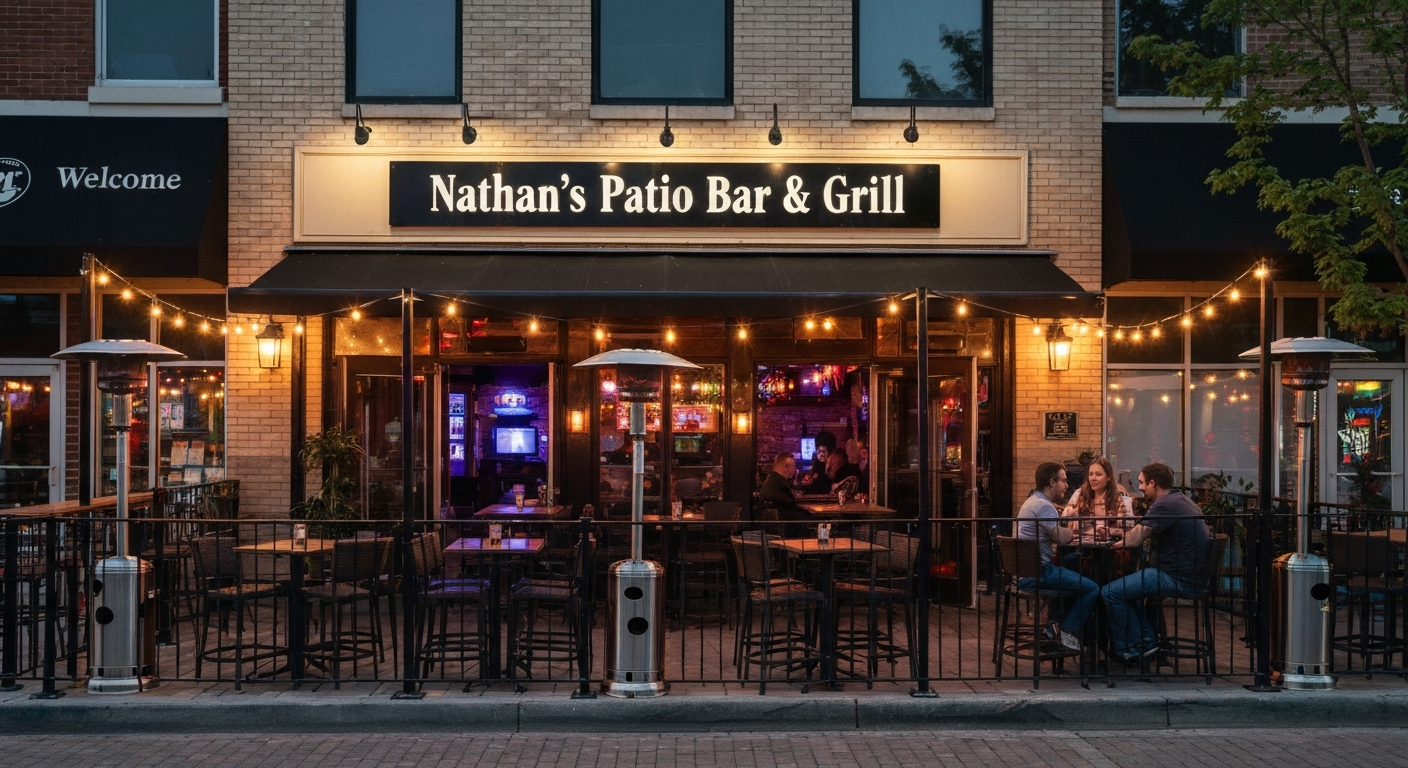
Patio bar-and-grill venues operating under the Nathan's name tend to follow the classic neighborhood patio formula: a main bar inside with an adjacent or wraparound outdoor section, string lights or overhead shade structures, and a casual eat-and-drink vibe that tilts toward sports viewing and social gatherings. Seating typically mixes bar-height tables, standard four-tops, and occasional lounge-style seating. Capacity in outdoor sections at venues this size usually runs between 40 and 120 guests depending on local permitting.
- Covered or partially covered patio sections for weather flexibility
- Outdoor bar service or roving server coverage on the patio
- Fire pits or patio heaters for shoulder-season use (venue-dependent)
- Big-screen or outdoor TV setups for sports viewing
- Accessible pathways from parking to the patio (confirm with venue for ADA compliance specifics)
- Pet-friendly patio policies at some locations (call ahead to confirm)
- On-site or adjacent parking, though weekend evenings can get tight
For accessibility specifically, always call the venue before a first visit if you or someone in your group has mobility needs. Outdoor patio surfaces vary, from level concrete to uneven brick or gravel, and not every venue has documented their ADA accommodations online. A 60-second phone call gets you a direct answer.
Current promotions and specials: how to find out what's running right now
Patio bar promotions change week to week, and the most reliable place to find live offers is the venue's own Facebook page or Instagram account, not third-party deal aggregators. Look for pinned posts or story highlights labeled 'weekly specials' or 'happy hour.' Most neighborhood patio bars run some version of happy hour pricing Monday through Friday between 3 PM and 7 PM, with weekend specials tied to sports events or live music nights. If you're planning a visit around a specific promo, verify it directly: either call the bar or send a DM on social media the day before.
- Happy hour drink and appetizer specials (typically weekday afternoons)
- Game-day food and drink bundles tied to local sports schedules
- Live music night specials (drink minimums or discounted cover charges)
- Seasonal patio opening promotions in spring and summer
- Private event packages that include food and bar minimums
- Loyalty or rewards programs if the venue has a digital presence
If the venue has a Google Business Profile, check the 'Offers' or 'Updates' section there too. Owners who actively manage their listing post specials and event previews directly in that feed, and it's often more current than the website.
Venue history and management structure
Without a confirmed single location on record, a universal founding date or ownership lineage cannot be stated here with accuracy. What can be said is that bars and grills operating under personal-name brands like 'Nathan's' are almost always independently owned rather than franchised. They typically trace back to a founder who either personally bears the name or chose it as a brand identity. Independent ownership like this means the management structure is usually flat: an owner-operator, possibly a general manager or bar manager one layer down, and front-of-house staff. There is no parent company layer or franchise royalty structure complicating the picture.
If the venue has changed hands, a title search on the property address or a review of SOS annual report filings over multiple years will show you when the registered agent or member list changed, which is the clearest paper trail for an ownership transition. Local newspaper archives and community Facebook groups are also useful: neighborhood patio venues often get coverage when they open, change owners, or close, and those stories stay searchable for years.
Step-by-step guide to verifying legal ownership
This is the process that actually works. Follow these steps in order and you will have a confirmed owner, or a clear explanation of why the record is ambiguous, within about 20 to 30 minutes.
- Confirm the exact city and state of the venue using Google Maps, a Google Business Profile, or the venue's own website. Write down the full street address.
- Go to that state's Secretary of State business search portal (search '[state name] Secretary of State business search' to find it). Enter the business name. Try variations: 'Nathan's Patio,' 'Nathans Patio Bar and Grill,' 'Nathan's Bar and Grill.'
- Open the filing record and note the entity type (LLC, corporation, sole proprietorship), the registered agent, the organizer or incorporator name, and any listed members or managers. Save or screenshot the record with the filing number and date visible.
- If the SOS record lists a registered agent service rather than a person, go to the county clerk's website for the county where the restaurant is located and search DBA or assumed name filings for the trade name 'Nathan's Patio Bar & Grill.' This will name the actual person or entity.
- For property ownership, go to the county assessor or recorder's website and search by the street address. The parcel record will show the legal property owner and the date of last recorded deed transfer.
- Check the county or city liquor license database. Many states publish liquor license holders publicly. The license will show the licensee name and license address, which often confirms the operating owner.
- Check local business license records through the city or county clerk. Business licenses are usually required annually and name the applicant.
- Cross-reference all three sources (SOS, property, liquor license). If they agree on a name, that is your confirmed owner. If they conflict, see the section below on dealing with ambiguous records.
How to find named staff and local personalities using public records and media
If you're trying to identify a specific person at the venue, like an owner, general manager, or a well-known on-site figure, the best starting point is the venue's own social media. Patio bars and local neighborhood restaurants frequently tag their staff, celebrate employee milestones, and introduce new hires on Facebook and Instagram. A search for the venue's official page plus the person's first name (for example, searching for 'Roxy' within the venue's tagged posts) often surfaces a last name, a role, and sometimes a direct contact.
Beyond social media, local news archives are underrated. Community newspapers, neighborhood blogs, and local TV station websites regularly profile bar and restaurant owners, especially around openings, anniversaries, or notable events. A Google search for the venue name plus 'owner' or 'interview' filtered to the last two or three years often pulls up a named profile. LinkedIn is also worth checking for managers and owners who maintain professional profiles, especially at venues that do significant private event business.
For on-site personalities specifically, asking directly when you visit is perfectly reasonable. Regular bartenders and servers at neighborhood patio bars are almost always happy to point you to the owner or manager if you ask politely and explain why you're asking. If you're a journalist, event planner, or researcher, saying so upfront gets you further faster.
Events and bookings: what planners need to know
For checking today's events or upcoming live music, the venue's Facebook Events page is the most reliable source at the neighborhood patio bar level. Most venues this size don't maintain a dedicated event calendar on their own website, so Facebook is where the schedule actually lives. Instagram Stories are also used for same-week event previews. If you're not seeing current event posts, that's a signal the venue may not be running regular programming right now, and a phone call will confirm it.
Private event booking checklist for planners
- Call or email the venue to ask if the patio or a section of it is available for private bookings and what the minimum spend or buyout requirement is.
- Schedule a site visit before committing. Walk the patio during a comparable time of day to your event to assess noise level, layout, and flow.
- Confirm exact capacity for your group: permitted outdoor capacity and indoor overflow capacity if weather turns.
- Ask about AV equipment: does the venue have its own sound system, microphone, or projector, or do you need to bring your own?
- Clarify catering: is it full menu service, a set event menu, or appetizers-only? Can you bring an outside cake or dessert?
- Get the deposit amount, refund policy, and cancellation window in writing before signing anything.
- Ask about parking for your group: is there adjacent or nearby parking, and can the venue arrange anything for larger groups?
- Confirm the rain or bad-weather policy for patio bookings specifically.
- Request a named contact person for day-of coordination and get their direct phone number.
- Review the contract for liability clauses, especially around alcohol service and guest conduct.
Dealing with ambiguous or conflicting ownership records
Sometimes the SOS filing, the property record, and the liquor license all name different entities or people. This happens more often than you'd expect, especially at venues that have changed hands informally, are mid-sale, or operate under a management agreement rather than direct ownership. Here's what to do when the records don't line up.
- If the SOS entity is dissolved or administratively revoked but the bar is clearly still open, the current operator may be running under a new entity name. Search the SOS portal for the current address or registered agent to find the active filing.
- If the property deed and the LLC record name different parties, the LLC is likely a tenant, not the property owner. Both records are valid but answer different questions: who operates the business vs. who owns the building.
- If the liquor license names a person not listed in the SOS or property records, that person is the licensed operator and often the de facto business owner. Contact the state liquor control board directly to request the full license application, which names the applicant and their ownership percentage.
- If records are more than two years old, re-run the search. SOS filings are updated annually in most states, and outdated screenshots circulating online create false ownership impressions.
- When records genuinely conflict and the stakes are high (legal dispute, lease negotiation, due diligence), escalate to a local attorney who can request certified copies of records and issue formal inquiry letters to the registered agent.
Avoiding mistaken identity: Nathan's Patio vs. similarly named venues
Patio bars and grills with similar names cause real confusion in search results, especially when you're looking for ownership or event information. Before you spend time on any public records search, make sure you've locked in the exact location of the Nathan's Patio Bar & Grill you're researching. A search result for a venue by the same name in a different city will give you completely wrong ownership data and send you in circles.
The same issue crops up with other popular patio venue names. Murphy's Law Patio, for example, appears under multiple names and ownership structures in different markets. The Patio at Horsham is another venue that generates search traffic and ownership questions, and its management and event schedule are entirely separate from anything named Nathan's. If you need specifics, search who owns the Patio at Horsham in local public records and business registries to find the registered owner. For up-to-the-minute listings and schedules, search for the patio at horsham events today to see what’s on the calendar. If you're navigating ownership questions for any of those venues, the same verification process described above applies: lock in the city and address first, then run the public records.
| Venue Name | Common Search Confusion | How to Disambiguate |
|---|---|---|
| Nathan's Patio Bar & Grill | Multiple locations across states may share the name | Add city and state to every search; confirm Google Maps listing |
| Murphy's Law Patio | Common generic name; may appear in multiple cities | Confirm street address and state before running SOS search |
| The Patio at Horsham | Specific to Horsham but generates broad patio search traffic | Specify 'Horsham' and county in all record searches |
| The Patio Restaurant | Very generic; dozens of unrelated venues | City + state + street address required before any verification |
A quick tip that saves a lot of time: when you're searching Google for ownership or contact info on any patio venue, put the full business name in quotes and add the city name outside the quotes. That combination filters out most of the name-collision noise and surfaces the specific location you need.
Practical next steps for diners, verifiers, and event planners
Whether you're just trying to grab a table on the patio or you're doing a full ownership verification for professional reasons, here's the condensed checklist that covers all three use cases.
For casual diners planning a visit
- Search the venue name plus city on Google to confirm the current address and hours on the Google Business Profile.
- Check the venue's Facebook or Instagram page for the current week's specials, live music schedule, or any closures.
- Call ahead if you have a large group (6 or more) or if you're visiting during a major sports event or holiday weekend.
- Ask about parking when you call, especially for evening visits.
For ownership verifiers and researchers
- Confirm the full street address and state of the specific location you're researching.
- Run the state SOS business search using the entity name and address.
- Pull the county DBA filing and property deed record to cross-reference the SOS filing.
- Check the state liquor control board's public license database for the licensee name.
- If records conflict, note the conflict and request certified copies before drawing conclusions.
- Use the phone script: 'Hi, I'm trying to confirm the owner or operator of record for this location for [your reason]. Could you tell me who I should contact or direct me to the right records?'
For event planners
- Reach the venue by phone first to establish whether private bookings are available and get a named contact.
- Follow up with an email summarizing your event date, guest count, and requirements so you have a paper trail.
- Complete the full booking checklist from the Events section above before signing a contract.
- Request a site visit at least two to four weeks before your event date.
- Confirm weather contingency options in writing, especially for patio-only bookings.
FAQ
Who owns Nathan's Patio Bar & Grill?
I can confirm the legal owner(s) — but I need the restaurant's city/state or full street address (or a link to its official website/Google Maps listing) to locate the correct business record. Multiple businesses can share a similar name; with a precise location I will search the state Secretary of State business registry, local county DBA records, and property/deed records to produce a sourced ownership statement (entity name, filing number, registered agent, last recorded owner, and permalinks or PDFs). If you provide the location, I will return verifiable documents and a clear ownership statement.
What should I expect in the article's ownership statement?
The article will either: 1) name the legal owner(s) with citations to the Secretary of State record, county property deed or business license; or 2) explain why ownership is ambiguous (e.g., multiple entities, DBA vs LLC, leased property) and give exact steps to confirm it. Every ownership claim will include a dated permalink to the primary source (SOS filing, county deed, or official local license).
If I don't have the address, how can I find the right Nathan's Patio Bar & Grill?
Search strategies: 1) Google: "Nathan's Patio Bar & Grill" plus city or zip code; 2) Google Maps or Apple Maps with the query; 3) Facebook/Instagram: search the name plus city; 4) local event listings (Yelp, TripAdvisor, DraftKings/Do512 for live-music towns). When you find a listing, copy the full street address or the Google Maps permalink and share it so I can pull official records.
What contact and visitor details will the article include?
The piece will list: full street address, phone number, official website, and verified social media links; current posted hours (with source and date), typical dress code (if published or typical for the area/venue type), patio amenities (shade, heaters, misters, outdoor bar, stage, heaters/firepits), indoor/outdoor seating capacity or typical party sizes, and current promotions (happy hour, food specials) with source links. If exact numbers (capacity) aren't publicly posted, I will explain how to obtain them (contact the manager or check local fire/occupancy permits).
How will you summarize the venue's history and management structure?
I will search local news archives, the business's "About" page, archived versions of its website (Wayback Machine), and Secretary of State filings to show founding date, ownership changes, franchise vs. independent status, parent company (if any), and named principals (owners/managers). All statements will be cited to the original documents or credible reporting; if history is unclear, I will state which records are missing and how to obtain them (interviews, FOIA for licensing records, property transfer deeds).
How can I verify ownership and find named staff or local personalities (e.g., "Roxy")?
Step-by-step verification: 1) Search the state Secretary of State business registry for the restaurant's exact trade name and any related LLC/DBA filings; 2) Check the county clerk or licensing office for a DBA (doing business as) or local business license listing; 3) Look up the county property assessor and recorder for the parcel, deed, and last sale/owner; 4) Search local news, trade press, and social media for interviews or manager profiles; 5) Call the business and ask for the manager/owner name (and cross-check with public filings). Useful search queries and sources will be supplied for the given location.