
It's August in Toronto, which means patios are in full swing across the city. Right now, hundreds of outdoor spots are open, from rooftop bars in King West to lakefront terraces at Harbourfront and packed beer gardens on the Danforth. Use the live patio finder on this page to see what's open today, filtered by neighbourhood, patio type, cuisine, party size and time. If you want to skip straight to verifying a specific spot before you head out, jump to the verification checklist below.
What Patios Are Open Toronto Today: Finder, Hours & Tips

Kira Carver
11 Aug 2026
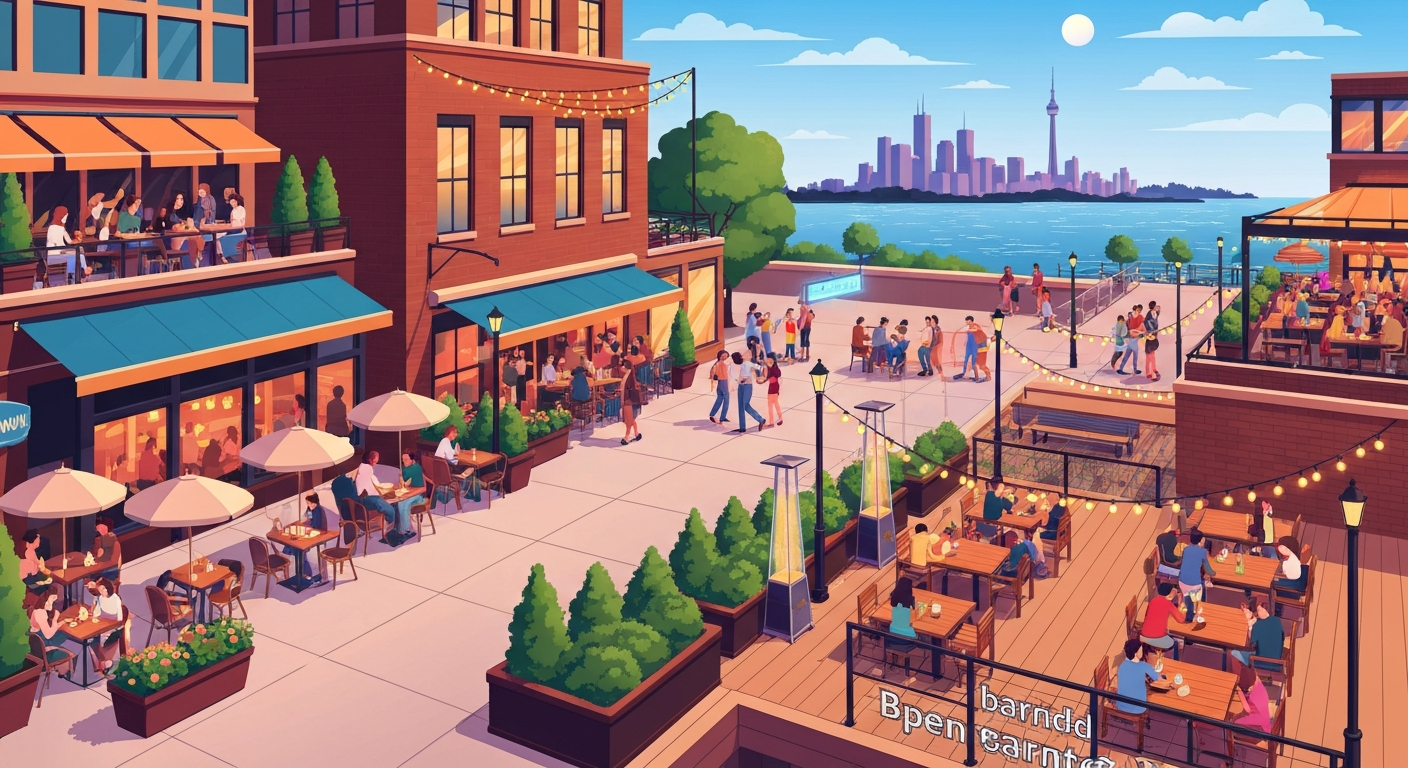
Quick patio finder: find patios open in Toronto today
The patio finder on this page pulls from a curated database of Toronto restaurants, bars, and entertainment venues with confirmed outdoor seating. It's built specifically for the 'open right now' question, not a static seasonal list, but a live-status view that reflects today's date, August 11, 2026, and updates as venues change their hours or temporarily close.
The guide covers the full range of Toronto patio scenes: sidewalk cafés regulated under the City's CaféTO program and Toronto Municipal Code Chapter 742, rooftop terraces, private lot patios, hotel terraces, beer gardens, parklets, and family or pet-friendly outdoor spaces. For every listing you'll find current open/closed status, hours, neighbourhood tag, patio type, cuisine, capacity range, a booking link where one exists, and any active promotions or seasonal menus worth knowing about. The City of Toronto provides neighbourhood boundary GIS datasets and interactive map services (neighbourhood polygon FeatureServer / shapefiles) that reporters and developers can use to map patio coordinates to City‑defined neighbourhoods for filtering blank" rel="noopener noreferrer">Toronto_Neighbourhoods FeatureServer (City / ArcGIS service).
How to use the live patio finder, filters explained
The finder has six filters you can combine in any order. Here's what each one actually does so you get useful results instead of a wall of listings.
- Neighbourhood: narrows results to Toronto's distinct districts — King West, Queen West, Harbourfront, The Beaches, Leslieville, Danforth, Yorkville, Liberty Village, the Junction and more. Boundaries follow the City of Toronto's official neighbourhood polygon data so the geography is consistent.
- Patio type: filter by rooftop, sidewalk/curb-lane café, parklet, beer garden, hotel or restaurant terrace, heated/covered patio, family-friendly, or pet-friendly. One venue can match several types.
- Cuisine: standard cuisine tags (Italian, Japanese, Canadian, bar food, brunch, etc.) pulled from each venue's own listing.
- Open now: shows only venues whose hours on today's date and current time confirm an open status. This is the most practical filter for same-day use.
- Date and time: if you're planning for later today or later this week, set a future date and time to see which patios will be open then.
- Party size: surfaces venues with enough outdoor capacity to seat your group. Useful for groups of 6 or more, where walk-in patio access gets tight on summer weekends.
For best results on a busy Saturday evening in August, start with your neighbourhood and party size, add 'open now,' and then layer in patio type or cuisine if you want to narrow further. Combining all six filters at once on a weekday morning will sometimes return zero results because smaller venues don't open until noon or later.
At-a-glance: patios open in Toronto today, sample results layout
Every listing card in the finder shows the same core information so you can compare spots quickly without clicking through to each venue page individually.
| Info field | What it tells you | How it's sourced |
|---|---|---|
| Status badge | Open now / Closes at X / Closed today | Venue hours + real-time check against current time |
| Today's hours | Opening and closing times for August 11 | Venue website, Google Business Profile, or direct confirmation |
| Patio capacity | Approximate number of outdoor seats (small/medium/large/XL) | Venue-reported or permit documentation |
| Cuisine & vibe tags | E.g., 'Canadian comfort, lively, dog-friendly' | Venue listing + editorial notes |
| Booking link | Direct link to OpenTable, Resy, or venue's own reservation page | Reserve with Google partners or venue URL |
| Neighbourhood | City-defined neighbourhood name | City of Toronto neighbourhood GIS data |
| Promotions | Any active happy hours, prix fixe, or seasonal menus | Venue-confirmed at listing update |
Capacity is shown in ranges rather than exact seat counts because outdoor capacities can shift based on weather setups, temporary closures of curb-lane sections, or private event bookings. If you have a large group or are planning an event, treat the capacity field as a starting point and confirm directly with the venue.
How to verify a patio's hours and real-time status
No aggregator, including this one, should be your only source on the day you're heading out. Listing data gets stale, venues update their hours without notifying every platform, and a curb-lane section might be removed for a special event or road work. Here's the verification stack I use and recommend.
Google Maps and Google Business Profile
Google Business Profile supports regular hours, special hours for holidays, a 'temporarily closed' flag, and live popular-times data. It's the fastest first check, search the venue name on Google Maps and look at the hours panel on the right. One important caveat: GBP data is editable by owners and by users, so a 'temporarily closed' tag may have been added by a third party and not reflect the venue's actual status. Always cross-check.
Reservation platforms
OpenTable shows live availability for date, time, and party size and supports an outdoor seating filter, if a venue has tables available on OpenTable for tonight, it's a strong signal the patio is open. Resy works similarly for the venues on its platform. Keep in mind that not every Toronto patio is on a reservation platform; many smaller spots are walk-in only, in which case platform availability is not a useful signal either way.
The venue's own website and social feeds
A venue's official website is the most authoritative source for hours. Many Toronto restaurants use schema.org structured data (FoodEstablishment and OpeningHoursSpecification fields) that machine-readable tools can parse, but you can just read the hours page directly. Instagram and Facebook are where most Toronto spots announce same-day closures, special events, or weather-related patio closures, a post from this morning is more reliable than a listing updated last month.
City of Toronto CaféTO and permit records
For curb-lane cafés and sidewalk patios specifically, the City of Toronto's CaféTO program page is worth bookmarking. The CaféTO program was made permanent by City Council and governs the seasonal operation of curb-lane dining in Toronto. The program publishes permit holder information, season dates, and contact details ([email protected]). If you want to confirm whether a particular sidewalk café is operating under a current permit, the City's program page is the primary public record. Toronto Municipal Code Chapter 742 defines the typologies (sidewalk café vs. curb-lane café vs. parklet) and the operational rules, including seasonal removal windows.
A quick phone call
For same-day plans, especially for larger groups or special occasions, a 30-second phone call is still the most reliable verification method. Ask specifically: is the patio open today, what time does it close, do you have room for your group, and is a reservation required? Document the name of who you spoke with and the time of the call. Verification Handbook / DataJournalism resources (verification best practices for journalists) recommends contacting primary sources directly (phone or email), recording the date/time, asking scripted verification questions, and documenting answers when confirming last‑minute closures, capacity, or special conditions. This is particularly important for rooftop venues, which close patios due to wind or lightning faster than sidewalk spots do.
Local verification steps, checklist to follow right now
- Search the venue on Google Maps and check today's hours in the business profile. Note whether it shows 'open now' or a specific closing time.
- Check for a 'temporarily closed' or 'permanently closed' label — if present, verify on the venue's official website or Instagram before assuming it's accurate.
- Visit the venue's Instagram or Facebook and look for any posts from the last 48 hours mentioning the patio, hours changes, or special events.
- If the venue is on OpenTable or Resy, search for tonight at your party size and check whether outdoor seating is available.
- Visit the venue's official website and confirm hours on the hours or contact page. If the site uses an online booking widget, that's a real-time signal.
- For curb-lane or sidewalk cafés, check the City of Toronto's CaféTO program page to confirm the venue holds a current permit for the current season.
- Call the venue directly if you're going for a group of 5 or more, it's a special occasion, or the online information across sources is inconsistent. Ask about outdoor capacity, reservation requirements, and weather contingency (covered/heated backup).
- If you're checking patios in nearby areas like Mississauga or Ottawa, note that hours and seasonal rules can differ from Toronto's, so repeat the verification steps for each city.
Typical patio season in Toronto and Ontario, when patios usually open and close
Toronto's patio season generally runs from late April through mid-October, with the peak window being Victoria Day weekend in May through Labour Day in early September. For a quick answer to when patios open in Toronto, see our 'when do patios open in Toronto' guide. That said, the actual dates vary significantly by venue type and by how adventurous the operators are with heaters and weather protection.
On the regulatory side, the City of Toronto's CaféTO program and Chapter 742 of the Municipal Code set seasonal constraints on when curb-lane café elements must be removed. Council decisions have cited a removal window of November 15 through April 14 for some curb-lane structures, though this can vary by permit conditions. What this means practically is that a restaurant with a permanent covered rooftop terrace can operate year-round (weather permitting and liquor licence allowing), while a business with a curb-lane parklet is working within a defined seasonal window set by the City.
The Alcohol and Gaming Commission of Ontario (AGCO) adds another layer: licensed outdoor patios require AGCO approval, and the application process typically takes around six weeks. Temporary extensions of outdoor patio licences are generally limited to 14 days or less and are capped per year. This matters for readers because a venue might have a great back patio in photos but not yet have their seasonal licence active, especially early in the season (May) or after an extension.
Factors that affect whether a patio actually opens on any given day beyond the formal season include: overnight low temperatures (most operators set a threshold around 8 to 10 degrees Celsius), rain forecasts, wind (especially relevant for rooftops), road work or utility projects affecting curb-lane sections, and private event buyouts. Heated and covered patios extend the practical season noticeably, some Yorkville and King West spots run their patios well into November with propane heaters and retractable roofs.
If you're curious about the broader Ontario picture or how Toronto's season compares to other Ontario cities, the patio season rules for the province follow the same AGCO licensing framework, though municipal permit rules differ city by city. For a province-wide overview and typical opening dates, see when do restaurant patios open in Ontario.
Where patios are concentrated by neighbourhood
Toronto's patio scene is not evenly spread across the city. These are the neighbourhoods where outdoor dining density is highest, what the vibe tends to be, and what types of patios you'll typically find.
| Neighbourhood | Patio density | Dominant patio types | Vibe |
|---|---|---|---|
| King West | Very high | Rooftop, hotel terrace, heated/covered | Upscale, lively, see-and-be-seen |
| Queen West | High | Sidewalk café, parklet, curb-lane café | Creative, casual, neighbourhood feel |
| Harbourfront / Lake Shore | High | Waterfront terrace, beer garden | Scenic, touristy in summer, family-friendly |
| The Beaches | Medium-high | Sidewalk café, casual patio | Relaxed, neighbourhood, dog-friendly |
| Leslieville | Medium | Sidewalk café, backyard-style patio | Laid-back, brunch-heavy, local crowd |
| The Danforth | Medium-high | Restaurant terrace, sidewalk café | Greek restaurant focus, social evenings |
| Junction | Medium | Beer garden, converted lot patio | Indie, unpretentious, craft beer culture |
| Yorkville | Medium | Hotel terrace, restaurant terrace | Upscale, European-style, dress code common |
| Liberty Village | Medium | Bar patio, rooftop | Young professional, sports bar crossover |
| Downtown core (Financial District) | Medium | Hotel terrace, rooftop bar | After-work crowd, weekday-heavy traffic |
King West and Queen West together account for a disproportionate share of Toronto's rooftop bars and higher-end patio experiences. If you're looking for volume and variety in a walkable radius, that stretch of the city is the most reliable. The Danforth is the best corridor for a traditional restaurant terrace dinner, especially in the evening when multiple spots are busy simultaneously. The Beaches and Leslieville skew more daytime and brunch, which fits a different kind of outing. Harbourfront is worth the trip in summer but can get genuinely crowded on weekends with festival foot traffic layered on top of regular diners.
Patio types in Toronto and what to expect from each
Not all patios are the same experience. Here's an honest breakdown of what each patio type delivers and what to watch out for.
Rooftop patios
Rooftop bars and terraces offer the best skyline views and tend to have a more curated atmosphere, dress codes are more common here than anywhere else in Toronto's outdoor dining scene. Most rooftops in King West and Yorkville have capacity limits that fill up fast on Friday and Saturday nights. Wind is a real factor; rooftop patios close faster than ground-level spots when storms roll in. Book ahead, confirm the patio is the part that's open (some venues have indoor and rooftop sections with different hours), and have a backup plan.
Sidewalk cafés and curb-lane cafés (CaféTO)
Sidewalk and curb-lane cafés are the most common patio type across Toronto. The CaféTO program made curb-lane dining permanent, so many Toronto restaurants now have a platform of tables extending into what used to be a parking lane. These are casual, street-level experiences, great for people-watching, often with no formal reservation required, and generally accessible. Noise from traffic and TTC streetcars is part of the deal on busier streets.
Parklets
Parklets are small, constructed outdoor seating platforms that convert parking spaces or curb lanes into public-facing dining or social space. They're defined formally under Chapter 742 and can range from a few café tables to a more elaborate structure with planters and lighting. They feel more permanent than a standard curb-lane setup and are common in neighbourhoods like Queen West and Leslieville.
Beer gardens
Beer gardens in Toronto are typically larger outdoor spaces, often on private lots or festival grounds, with communal seating, a strong draft lineup, and a more casual, social atmosphere. The Junction has a solid cluster of these. They're the best option for large groups who want a relaxed evening without formal table service. Some operate seasonally and don't take reservations at all.
Hotel and restaurant terraces
Hotel terraces tend to be better equipped for all-weather dining (think retractable roofs, heaters, and more substantial covered structures) and are often open for longer hours. Restaurant terraces in Yorkville or on the King West strip lean into the full dining experience rather than just drinks, with full menus and table service. These are the go-to for special occasions or when you want outdoor ambiance without sacrificing service quality.
Family-friendly patios
Family-friendly patios typically have more space between tables, a kids' menu, high chairs, and earlier service windows. The Beaches, Leslieville, and parts of the Danforth have the best concentration of these. Some of the Harbourfront patios are family-friendly by nature given the waterfront park setting. Worth confirming when you call ahead whether strollers are practical in the outdoor area.
Pet-friendly patios
Toronto has a reasonably good number of dog-friendly patios, particularly in The Beaches, Leslieville, and the Junction. Ontario's public health regulations generally allow dogs in the outdoor areas of licensed establishments at the restaurant owner's discretion (dogs are not permitted indoors where food is prepared or served). Always confirm a patio is dog-friendly before you go, the policy varies by venue and some have specific spots (often a roped section away from food service) designated for dogs.
Heated and covered patios
Heated and covered patios extend the usable season from early April into November and make rainy summer evenings viable. Propane patio heaters are the most common setup; some higher-end venues have infrared ceiling heaters and retractable glass or polycarbonate roofing. If you're planning a patio outing on a marginal weather day, filtering specifically for heated or covered patios in the finder is your best move. These spots stay open when others close down.
Tips for groups and event planners
Groups of 8 or more should not rely on walk-in patio access in Toronto between May and September, especially on Thursday through Sunday evenings. Peak-season patio bookings at popular King West and Harbourfront venues fill up two to three weeks in advance for weekend evenings. If you're planning a corporate lunch, birthday dinner, or team outing, treat the patio reservation as seriously as you would an indoor private dining room.
- Book at least two weeks out for groups of 6 or more on a Friday or Saturday evening in July and August.
- Ask the venue about their weather contingency: do they move groups indoors, or is the patio your only option? A venue without a covered indoor fallback is a risk for outdoor events.
- Confirm whether the outdoor area can be semi-privatized for your group, and if there's a minimum spend or a room fee attached.
- Check the AGCO-licensed capacity of the outdoor section — venues can't exceed it, so an outdoor 'capacity 40' patio cannot seat your group of 50.
- For accessibility, ask specifically about step-free access to the patio, table height and chair type, and whether accessible washrooms are on the same level as the outdoor seating.
- On rooftop venues, confirm elevator access if anyone in your group has mobility limitations.
Checking nearby cities: Mississauga, Ottawa, Montreal, and Calgary
If you're based just outside Toronto or travelling from a nearby city, the same verification approach applies, but the municipal rules, permit programs, and seasonal windows are different in each city. Mississauga patios follow Peel Region licensing rules and don't have a CaféTO equivalent; the patio landscape there is more suburban and spread across commercial corridors rather than concentrated in walkable neighbourhoods. Ottawa has a distinct patio scene with its own seasonal patterns, particularly around the Byward Market and Elgin Street. Montreal operates on a different regulatory framework entirely, with its own city-specific permit system and a patio culture shaped by Quebec's distinct restaurant licensing rules. Calgary's patio season is shorter due to climate, and the city's downtown and Mission/17th Avenue corridors carry most of the outdoor dining density.
This guide covers Toronto specifically, but the Patio Restaurant Guide has dedicated city pages for Mississauga, Ottawa, Montreal, and Calgary where you'll find the same live-status finder, neighbourhood breakdowns, and verification resources tailored to each city's rules and patio culture. For visitors curious about Chicago's seasonal schedule, see our dedicated Chicago page covering 'when do patios open in Chicago' for local opening windows, permit rules, and neighbourhood hotspots. If you're interested in patios open in Calgary today, check the Calgary city page for a live-status finder and neighbourhood breakdowns. There’s also a dedicated page for Best Intentions Chicago patio if you’re comparing Toronto options with notable Chicago spots. For Montreal-specific live status and permit details, see are patios open in montreal.
FAQ
Which patios in Toronto are open today?
There’s no single public list guaranteed accurate for every venue at every minute. For a quick, same‑day check: 1) search Google Maps / the venue’s Google Business Profile for "open now" and special hours; 2) check real‑time reservation platforms (OpenTable, Resy, Yelp Reservations) for outdoor‑seating availability; 3) visit the venue’s official website (look for openingHoursSpecification/schema.org data) and social feeds for last‑minute updates; 4) if in doubt, call the venue to confirm. For permitted curb‑lane and sidewalk patios, consult the City of Toronto’s CaféTO program or permit lists as a baseline for which venues operate regulated patios.
How can I filter patios by neighbourhood, type and cuisine?
Use layered filters across sources: 1) Neighbourhood — map searches in Google Maps or OpenTable plus the City of Toronto neighbourhood map (GIS/Open Data) let you narrow results; 2) Type — include keywords like "rooftop", "beer garden", "family‑friendly", "pet‑friendly", "curb lane patio", or "parklet" in searches and look for CaféTO/municipal permit labels to identify curb‑lane or sidewalk patios; 3) Cuisine — use platform filters (OpenTable, Google, Yelp) for cuisine tags. For a custom finder, combine venue coordinates with the City neighbourhood polygon dataset to categorize patios by official neighbourhood boundaries.
What practical details should I check before I go?
Checklist to confirm before leaving: 1) Hours (regular and special/today hours); 2) Outdoor availability / "outdoor seating" filter or manual note; 3) Reservation options and live availability; 4) Dress code or temperature/blanket policies; 5) Amenities (heaters, umbrellas, shade, restrooms, Wi‑Fi); 6) Accessibility (step‑free access, ramps, accessible washrooms); 7) Pet policy; 8) Payment methods and gratuity rules; 9) Promotions or fixed menus; 10) Cancellation and weather/back‑up plans. Verify via the venue website/GBP, booking platform, and one phone call when needed.
How do we verify hours and real‑time patio status reliably?
Use a multi‑source verification workflow: 1) City sources — CaféTO permit lists and program pages for regulated patios; 2) Google Business Profile/Maps for "open now" status and special hours (cross‑check since both owners and users can edit); 3) Reservation platforms (OpenTable/Resy/Yelp Reservations) for live availability and booking; 4) Venue website and structured data (schema.org OpeningHoursSpecification); 5) Social feeds (Instagram/X/Facebook) for immediate updates; 6) Phone call to the venue (record date/time and answers). Combining these reduces false positives from stale listings.
When is patio season in Toronto and when do patios usually open/close?
Patio timing varies by operator and permit type. The City’s CaféTO program and related Council decisions define operating seasons and permit removal windows (examples in Council reports and municipal code). Many curb‑lane/temporary elements have program‑defined removal windows (municipal guidance cites seasonal windows such as mid‑November to mid‑April for removal of some elements). Individual rooftop and private‑lot patios can operate under their licences and weather/owner policy. Always confirm specific dates with the venue and the City program for permitted patios.
What patio types will I find in Toronto and how are they defined?
Common types and how to classify them: 1) Curb‑lane cafés / parklets — on public curb lanes or sidewalk extensions, often part of the CaféTO program and subject to municipal permits; 2) Sidewalk cafés — frontage patios adjacent to sidewalks, regulated by municipal code; 3) Rooftop/terrace patios — private property; 4) Beer gardens — larger outdoor areas, often private lots or rooftop spaces; 5) Private‑lot patios — patios on a venue’s property (not City right‑of‑way). Use Chapter 742 and City Council definitions to classify patios formally.