
Yes, patios are open in Montreal right now. Today is July 15, 2026, which puts you squarely in the middle of peak patio season. The city's official terrace season runs April 15 to November 15, and most venues are fully set up with furniture, umbrellas, and staff outside. That said, whether any specific patio is open today depends on the venue's own hours, the weather, and whether they've received their arrondissement permit for the season. This guide walks you through how to confirm status in real time, what drives openings and closures throughout the year, and how to get the most out of Montreal's outdoor dining scene.
Are Patios Open in Montreal? Check Now + Seasonal & Rules

Kira Carver
15 Jul 2026
Quick answer: are patios open in Montreal today
Montreal's city-wide default allows commercial terraces to operate from April 15 through November 15, with standard hours of 07:00 to 23:00. Since we're in mid-July, the vast majority of permitted patios across the island are open and running at full capacity. Summer is when Montreal's outdoor dining culture really hits its stride, with sidewalk terrasses, rooftop bars, and curbside setups buzzing from lunch through late evening. The practical caveat is that each arrondissement (borough) sets its own rules, so hours, layouts, and even whether a terrace is permitted at all can vary by neighborhood. Ville-Marie, for example, runs its patio season from May 1 to October 31 with slightly different weekday and weekend closing times. A handful of boroughs, including Outremont, don't permit commercial terraces on the public domain at all. So "Montreal patios are open" is the right general answer in July, but always confirm the specific spot you're heading to.
If you're also planning trips to other Canadian cities or want to compare patio seasons across regions, guides for patios open in Ottawa today, patios open in Calgary today, and what patios are open in Toronto cover those cities in the same practical format. For nearby options, see which patios are open in Mississauga for a similar, up-to-date listing. For Toronto-specific timing and rules, see our guide on when do patios open in Toronto for city-by-city permit windows and practical tips. For U.S. comparisons, see our guide on when do patios open in Chicago for timing and permitting differences in that city. If you're curious about Chicago options, see the Best Intentions Chicago patio guide for a comparable overview and practical tips.
How to check patio status in real time
The most reliable way to know if a specific patio is open right now is to use a combination of official sources and the venue's own live channels. Here's what actually works.
Official municipal sources
Montreal's official terrace permitting page (montreal.ca, under 'Installer une terrasse commerciale sur le domaine public') lists the rules for each arrondissement. This tells you the permitted season window and hours for any given borough, which is the legal framework venues must operate within. If you want to know whether a venue's terrace permit is in good standing, you can contact the borough's Comptoir des permis directly using the phone number or email listed on the arrondissement page. For quick questions, the city's 311 service is the fastest route to a human who can point you in the right direction.
Reservation apps and Google Maps
OpenTable, Resy, and similar booking platforms often show real-time availability for patio seating specifically. When searching, look for listings that let you select 'outdoor seating' as a preference. Google Maps is also genuinely useful here: the 'Popular times' feature shows current busyness, and the 'outdoor seating' attribute on a venue's listing (when the owner has updated it) signals that a terrace exists. Check the hours listed and look at recent photos sorted by date to get a visual read on whether the patio is currently set up.
Social media
Instagram is surprisingly reliable for same-day patio confirmation. A quick search of the venue's handle or a tagged location check will usually surface a post or Story from that day or the day before. Many Montreal restaurants and bars post when their terrace opens for the season or when they're closing early due to rain. Facebook Events is also useful for spotting patio-specific programming like weekend brunches or evening events that confirm the space is active.
Just call or send a DM
Honestly, calling the restaurant is still the fastest confirmation for same-day plans. A 30-second phone call tells you if the patio is open, whether reservations are needed, and if there's a wait. Most venues in Montreal are also responsive to Instagram DMs, especially smaller spots where the owner is running the account.
Step-by-step: confirming a specific venue is open
Whether you're calling, sending a DM, or emailing, you want to cover the same core questions so you're not caught off guard when you show up. Here's the sequence I use when I'm pinning down a specific spot for a group or a special occasion.
- Confirm the terrace is open today and what time service starts and ends.
- Ask if the patio requires reservations or if walk-ins are welcome (this changes dramatically from weekday lunch to Friday evening).
- Ask about the seating setup: full outdoor, covered/heated, or partially enclosed — especially relevant if rain or wind is in the forecast.
- Check the dress code if you're going somewhere with a more curated vibe (most Montreal patios are casual, but rooftop bars sometimes enforce a smart-casual standard).
- Ask about the group size minimum or maximum for their outdoor section, and whether they hold private events on the terrace.
- Confirm any current promotions, happy hour windows, or events (many summer patios run weekly specials like pétanque nights or live DJ sets).
- If accessibility matters for your group, ask specifically about step-free access to the terrace, since sidewalk and elevated setups vary widely.
- For event planning: ask about private buyouts, minimum spends, A/V equipment availability, and whether the venue has a dedicated event contact.
If you're emailing, keep it short. List your date, party size, and the two or three questions that matter most. You'll get a faster, cleaner answer than a multi-paragraph inquiry.
Seasonal timeline: what to expect month by month
Montreal's patio season is real, but it's also compressed. You've got roughly seven solid months on paper, and maybe four or five truly comfortable outdoor months in practice. Here's how it plays out.
| Season | Approximate Dates | What to Expect |
|---|---|---|
| Spring thaw | Mid-April to late May | Permit season opens April 15. Early weeks can be cold and patchy — some venues hold off until May. Look for heated terraces and windbreaks. Crowds are light, which is a bonus. |
| Summer peak | June through August | Full swing. Nearly every permitted patio is set up and staffed. Rooftops, sidewalk terrasses, and beer gardens are all operating. Reservations are strongly recommended on weekends. |
| Fall taper | September to mid-November | Still comfortable in September. October cools quickly. Covered and heated terraces extend the season into November. Permit season closes November 15 for most boroughs. |
| Winter | Mid-November to mid-April | Standard open-air patios are closed. Some venues with enclosed structures (domes, heated semi-enclosures) operate under specific permits. Check individually — this is venue-by-venue territory. |
Arrondissement rules can shift these windows. Ville-Marie's terrace season, for instance, runs May 1 to October 31, which is slightly tighter than the city default. Always cross-check the borough your venue sits in. The comparison is similar to how patio season timing varies between cities, if you've looked at when do patios open in Toronto or when do restaurant patios open in Ontario, you'll notice Montreal's spring window actually opens around the same time as southern Ontario.
How weather and forecasts affect patio openings
Even if a venue has a valid permit and it's technically within the operating season, operators make game-day calls based on weather. Temperature is the obvious factor: most Montreal patios see a drop in service quality when it dips below about 10°C, and many close their outdoor section entirely below 5°C unless heating is available. Wind is underrated as a factor. A 30 km/h wind on an otherwise nice day makes a sidewalk terrace genuinely uncomfortable, and umbrellas become a liability. Rain is the most immediate trigger for same-day closures, especially for open-air setups without a covering.
For planning purposes, check Environment Canada's Montreal forecast (weather.gc.ca) the day before and the morning of your visit. Venues with covered or heated terraces are much more weather-resilient, so if you're planning a special occasion during shoulder season (May or October), prioritize those types of patios. During peak July and August, weather closures are less common but afternoon thunderstorms do roll through, so keep an eye on the hourly forecast if you've got an evening reservation. Many venues will move guests inside temporarily and reopen the terrace once a storm passes.
How heating, coverings and windbreaks extend the season
The tools venues use to push the season past comfortable temperatures are heating, overhead coverings, and wind barriers. Each comes with its own rules and practical limits in Montreal.
Heating options and what's actually allowed
Montreal's public-domain terrace regulations explicitly prohibit portable gas cylinders and portable fuel-fired supplemental heaters on terraces. Fixed, approved electric heating systems may be permitted, but this varies by arrondissement. Any gas installation must comply with Quebec's provincial building code and the CSA B149 gas installation standards, which the Régie du bâtiment du Québec (RBQ) enforces. TSSA's patio‑heater safety guidance stresses proper positioning, keeping propane bottles away from operating heaters, ventilation to reduce CO risk, and staff training, and notes Quebec operators must combine equipment‑manufacturer instructions with RBQ/CSA B149 code requirements and any municipal permit conditions Safety notes on patio heaters — TSSA (safety guidance) — (practical heater-safety guidance). The practical upshot for diners: if a venue has overhead electric radiant heaters mounted to a pergola or ceiling structure, those are likely permitted and effective. If you see portable propane mushroom heaters on a public sidewalk terrace, that's a red flag worth noting, since those are not permitted in this context under city rules.
Coverings and enclosures
Retractable awnings, fixed pergolas with transparent panels, and full enclosures like domes each sit in different regulatory buckets. Some municipal regulations in Quebec allow rigid or semi-rigid domes and shelters under defined conditions, sometimes with specific seasonal windows (there are examples of dome/abri allowances for periods like October 1 through April 30). Whether a specific enclosure is permitted on a specific terrace comes down to the borough-level permit. A venue that runs a winter dome setup has gone through additional authorization to do it. When in doubt, ask the venue directly whether their enclosure is a licensed seasonal structure.
Windbreaks
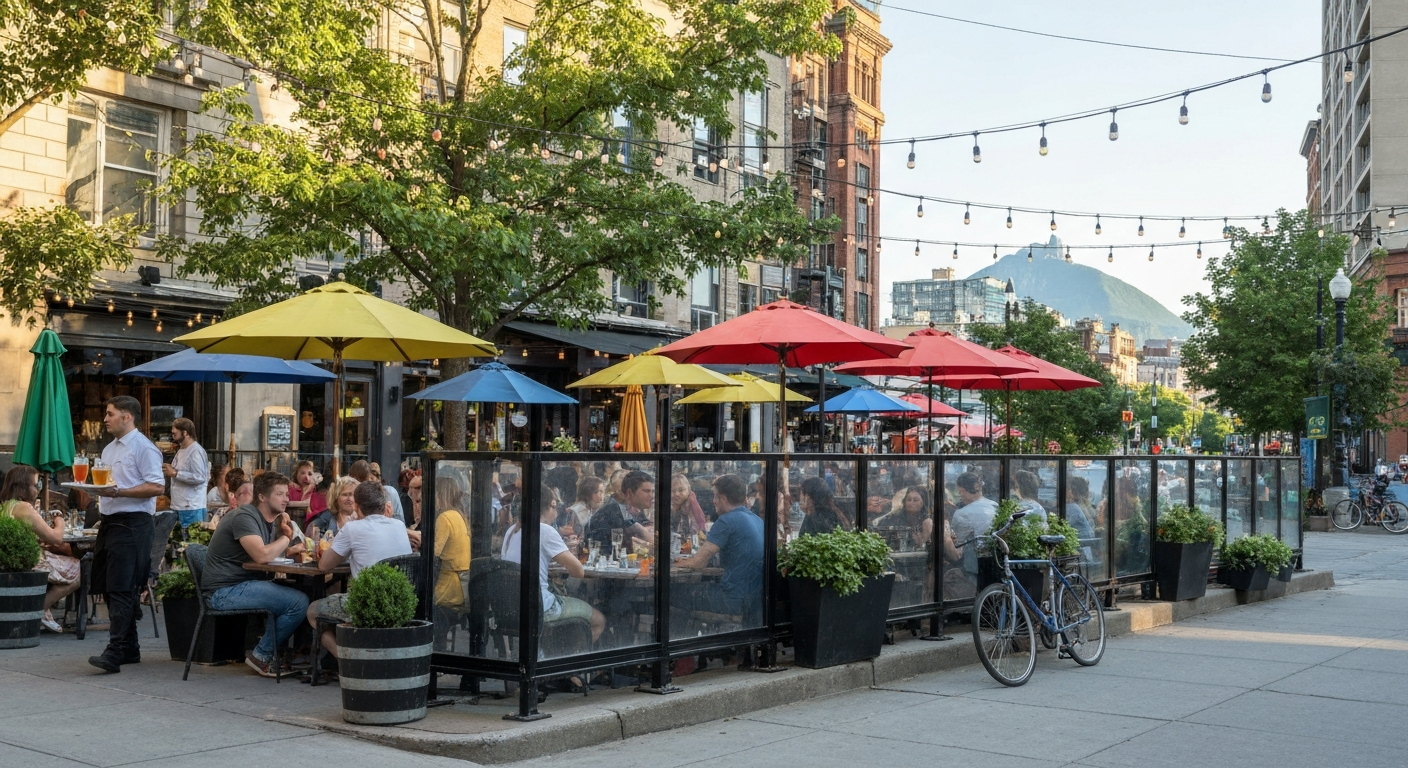
Tempered glass panels, planters, and architectural wind barriers are the most common tools for extending comfort on exposed terraces. These generally fall within standard permit parameters as long as they respect the layout dimensions in the borough permit. They don't extend the legal season, but they make the actual experience much more comfortable in spring and fall. If you're doing a shoulder-season visit and comfort matters, filter for covered patios or look for venues that reference wind protection in their descriptions.
Types of patios in Montreal and what you'll find at each
Montreal's patio landscape is genuinely varied. The city's density and architectural mix produce some really distinct outdoor dining formats, each with a different vibe and set of practical considerations.
| Patio Type | Typical Setup | Common Amenities | Best For |
|---|---|---|---|
| Sidewalk terrasse | Tables set directly on or adjacent to the public sidewalk, often demarcated by planters or barriers | Umbrellas, wind panels, street-facing views, passing foot traffic | Casual lunches, people-watching, grab-and-go cocktail hour |
| Curbside/parking lane terrasse | Extended footprint using former parking spaces under city temporary lane programs | More tables than sidewalk-only setups, sometimes planters and lighting | Groups, neighborhood bar vibes, summer evenings |
| Rooftop terrace | Elevated outdoor space on top of a building, often with panoramic city views | Bar service, lounge seating, DJs or live music, often a smart-casual or upscale atmosphere | Date nights, celebrations, cocktail-forward experiences |
| Covered/heated terrace | Permanent or seasonal roof covering with electric heaters, glass walls, or full enclosure | Year-round or extended-season operation, weather protection, often reservable private sections | Shoulder season dining, events, groups that can't risk rain |
| Garden/courtyard patio | Private outdoor space behind or beside a building, usually quieter than street-facing terrasses | Greenery, string lights, more intimate seating, sometimes fire features | Romantic dinners, private events, quieter outdoor experience |
| Private event terrace | Dedicated buyout space for groups or corporate events, may be semi-enclosed | Private bar, A/V, catering minimums, dedicated staff | Corporate events, large group bookings, milestone celebrations |
The Plateau-Mont-Royal and Mile End neighborhoods are classics for sidewalk terrasses with neighborhood character. Downtown and the Old Port lean toward rooftop and riverfront setups with a more polished atmosphere. NDG and Rosemont have quieter garden patios that tend to be less crowded. When you're searching for a venue, having a sense of which format suits your occasion saves a lot of back-and-forth.
Practical things to know before you go
A few operational details that regularly catch people off guard on Montreal patios.
Hours and noise rules
The default city-wide closing time for terraces is 23:00. Some boroughs are stricter, and Ville-Marie (which covers much of downtown and the Plateau) has its own weekday and weekend closing-time breakdown. Live music and amplified sound on terraces is subject to additional noise bylaws, so don't assume a patio that lists live entertainment is automatically permitted for loud amplified sets after a certain hour. If you're planning an event with entertainment, ask the venue specifically whether their permit covers amplified music outdoors.
Alcohol service
Terrace alcohol service in Quebec is governed by the Régie des alcools, des courses et des jeux (RACJ). Venues must have their liquor authorization explicitly cover the terrace area. The RACJ can restrict, modify, or suspend terrace-related licences, and venues need to apply for any changes to their licensed outdoor area. See the RACJ, Guide (RACJ-1042) / instructions for alcohol-permit applications and changes, Régie des alcools, des courses et des jeux, which explains how holders can apply to modify terrace permits (temporary changes, extensions, relocations, or additional hours) and notes the Régie can restrict or suspend terrace-related licences blank" rel="noopener noreferrer">RACJ — Guide (RACJ-1042) / instructions for alcohol-permit applications and changes — Régie des alcools, des courses et des jeux. For diners, this mostly means: if a venue is new or recently expanded their terrace, their outdoor alcohol service could be pending approval, so it's worth confirming if that matters for your visit.
Accessibility
Sidewalk and curbside terrasses in Montreal vary widely on step-free access. Some are at street level with no barriers; others involve small platform elevations that require a step up. Rooftop terraces depend entirely on the building's elevator access. If accessibility is a factor for your group, call ahead and ask specifically about the route from the entrance to the outdoor section. Don't assume a restaurant with an accessible interior entrance automatically has step-free terrace access.
Dress codes and vibe
Most Montreal terrasses are relaxed. Jeans, sneakers, and a t-shirt will get you into 90% of spots without a second look. Rooftop venues and hotel terraces in the downtown core are more likely to enforce smart-casual standards, especially after 9 PM. Check the venue's Instagram before you go if you're unsure, the visual tone of their posts will tell you more than any written dress code.
Reservations and walk-ins
Weekday lunches and early weekday evenings are generally walk-in friendly at most Montreal patios through July. Weekend afternoons and evenings from June through August are a different story. Popular spots fill their outdoor sections by 18:00 on Fridays and Saturdays. If you've got a specific venue in mind for a weekend evening, book at least two to three days in advance. For groups of six or more, a reservation isn't optional in summer, walk-in groups that size will almost always be turned away or face a 45+ minute wait.
Using Patio Restaurant Guide listings and filters to find Montreal patios
The Patio Restaurant Guide listings for Montreal include venue-specific details on patio type, hours, amenities, current promotions, and accessibility notes. Here's how to get the most out of them when you're actively looking for a spot.
Search tips
- Search by neighborhood rather than just 'Montreal' to narrow results to walkable options. Try searches like 'Plateau terrasse' or 'Old Port rooftop patio' for more targeted results.
- Use the outdoor seating type filter to separate sidewalk terrasses, rooftop patios, and covered/heated options. This matters a lot in shoulder season.
- Filter by amenities if you need specific features: heated, covered, dog-friendly, private event space, or live entertainment. Each of these filters corresponds to confirmed venue details in the listing.
- Sort by 'open now' during business hours to see only venues with current operating status confirmed in their listing details.
- Check the listing's 'last verified' date. Listings with recent verification dates reflect current seasonal status more reliably than older entries.
What listing details actually mean
When a listing says 'heated terrace,' that means the venue has confirmed some form of supplemental heating on the outdoor space, whether electric overhead heaters, enclosed radiant panels, or a partial enclosure with heat. It does not guarantee comfort in January. 'Covered patio' means there is overhead protection from rain, but the sides may or may not be enclosed. 'Private event space' means the venue has confirmed they accept buyout bookings for that outdoor area, but you should still call to discuss minimums and setup. Hours listed reflect the venue's own operating hours for the terrace section, which may differ from indoor dining hours and are subject to change on short notice due to weather or staffing.
Event planning with the guide
If you're using Patio Restaurant Guide to plan a private event or a multi-venue evening, the filter for 'private event patio' combined with a capacity filter will get you a shortlist fast. From there, use the contact details in each listing to reach the venue's events team directly. Most listings include a direct phone number or event inquiry email, which is faster than going through general reservations. Montreal venues that host terrace events regularly also post seasonal promotions and event calendars in their listing pages, so check those before you reach out, your question about availability may already be answered.
Quick checklist for visiting or booking a Montreal patio
Pull this out before you head out or start making calls. It covers everything from solo lunch to group event planning. For another relevant comparison, see what patios are open toronto. For another relevant comparison, see patios open in ottawa today. For another relevant comparison, see patios open in calgary today.
- Check today's weather forecast (Environment Canada, hourly view) and confirm the venue has a covered or heated option if conditions are marginal.
- Verify the venue's patio is open today via their website, Google Maps listing, or a quick call or DM.
- Confirm operating hours for the terrace specifically — outdoor sections sometimes close earlier than the indoor dining room.
- Book a reservation if your group is four or more, or if it's a weekend evening in June, July, or August.
- Ask about the dress code if you're heading to a rooftop or hotel terrace.
- Confirm step-free access if anyone in your group needs it.
- Check whether the terrace allows dogs if you're bringing a pet.
- Ask about active promotions, happy hour windows, or events that week.
- If you're booking a private event, confirm minimum spend, permit for amplified music, and alcohol service coverage for the outdoor area.
FAQ
Are patios open in Montreal today — how can I verify current status for a specific venue?
There’s no single city-wide “open/closed today” feed. To verify a patio’s status: (1) check the establishment’s website, Google Business listing, Instagram/Facebook or Yelp (most update hours/closures); (2) call the venue directly; (3) consult montreal.ca’s terrace pages for borough rules that affect opening/season windows; (4) contact your arrondissement’s Comptoir des permis or call 311 for quick municipal confirmation; (5) if on site, look for the municipal terrace permit or posted hours. Use multiple sources (venue + borough) for the fastest, most reliable answer.
What is the normal patio season in Montreal and who sets the dates?
The city’s default framework lists a typical season of April 15–November 15, but boroughs (arrondissements) can set different windows. Many restaurants aim to open patios in April–May and close in October–November, but the exact dates depend on the arrondissement permit and venue readiness (staffing, weather, safety). Always check montreal.ca and your arrondissement’s permit page for the authoritative season dates.
Which municipal and provincial rules determine whether patios can open or use heaters/enclosures?
Key rules come from three places: (1) Montreal’s terrace/permit rules (montreal.ca) set permit, seasonal, layout and public‑domain rules; (2) borough pages may impose local variations (some arrondissements even prohibit public‑domain terraces); (3) provincial building/gas codes enforced by the Régie du bâtiment du Québec (RBQ) and CSA standards (e.g., CSA B149) govern gas/propane/electrical installations. Additionally, the Régie des alcools (RACJ) controls alcohol‑service permissions that affect terrace hours and relocations. Check all three when planning heaters or enclosures.
Are portable propane heaters allowed on Montreal patios?
Portable fuelled (propane) heaters and portable fuel cylinders are generally prohibited on public‑domain terraces under Montreal guidance; many boroughs forbid them outright. Fixed or approved electric heating systems may be permitted if they comply with RBQ/CSA codes and the local permit terms. Always verify the arrondissement’s rules and the RBQ/CSA requirements before installing or using any heater.
How do coverings, domes or partial enclosures affect patio season length?
Covered or partially enclosed patios (awnings, rigid/semi‑rigid domes) can extend the service season by protecting guests from wind, rain and cooler temperatures. However, municipality and provincial rules restrict types and timing of enclosures—some boroughs allow them only under specific seasonal windows or with additional permits and technical compliance. Any enclosure that changes ventilation, fire risk or gas/electrical installation will require permit review and code compliance, so confirm with your arrondissement and RBQ rules first.
What types of patios exist in Montreal and what amenities do they usually offer?
Common patio types: (1) Sidewalk terraces — on public sidewalks, require municipal permit and must keep pedestrian clearance; (2) Curbside/parklet terraces — occupy parking lanes or curbside space with stronger permit/insurance requirements; (3) Private‑yard courtyards — inside property line, simpler municipal rules but still may need permits; (4) Rooftop patios — subject to building, structural and fire-code approvals; (5) Heated/covered patios — use approved fixed heaters or permitted enclosures. Typical amenities: seating, umbrellas, heating (if permitted), temporary windbreaks, outdoor lighting, service stations, and sometimes music/entertainment (subject to local noise rules). Permits and insurance often require specific plans for layout, materials and safety.