
Most patio theaters are genuinely safe when the venue is properly permitted, staffed, and maintained. The real question is not whether outdoor performance patios are dangerous by nature, but whether the specific one you are visiting has done its homework: posted occupant loads, solid furniture, clear exits, trained staff, and a weather plan. Run through the quick checks in this guide and you will know within a few minutes whether a venue clears the bar. If you want to know whether are active scene patios real, see the linked checklist for a focused verification process.
Is the Patio Theater Safe Essential Safety Checklist & Guide

Kira Carver
11 Aug 2026
What exactly is a patio theater?
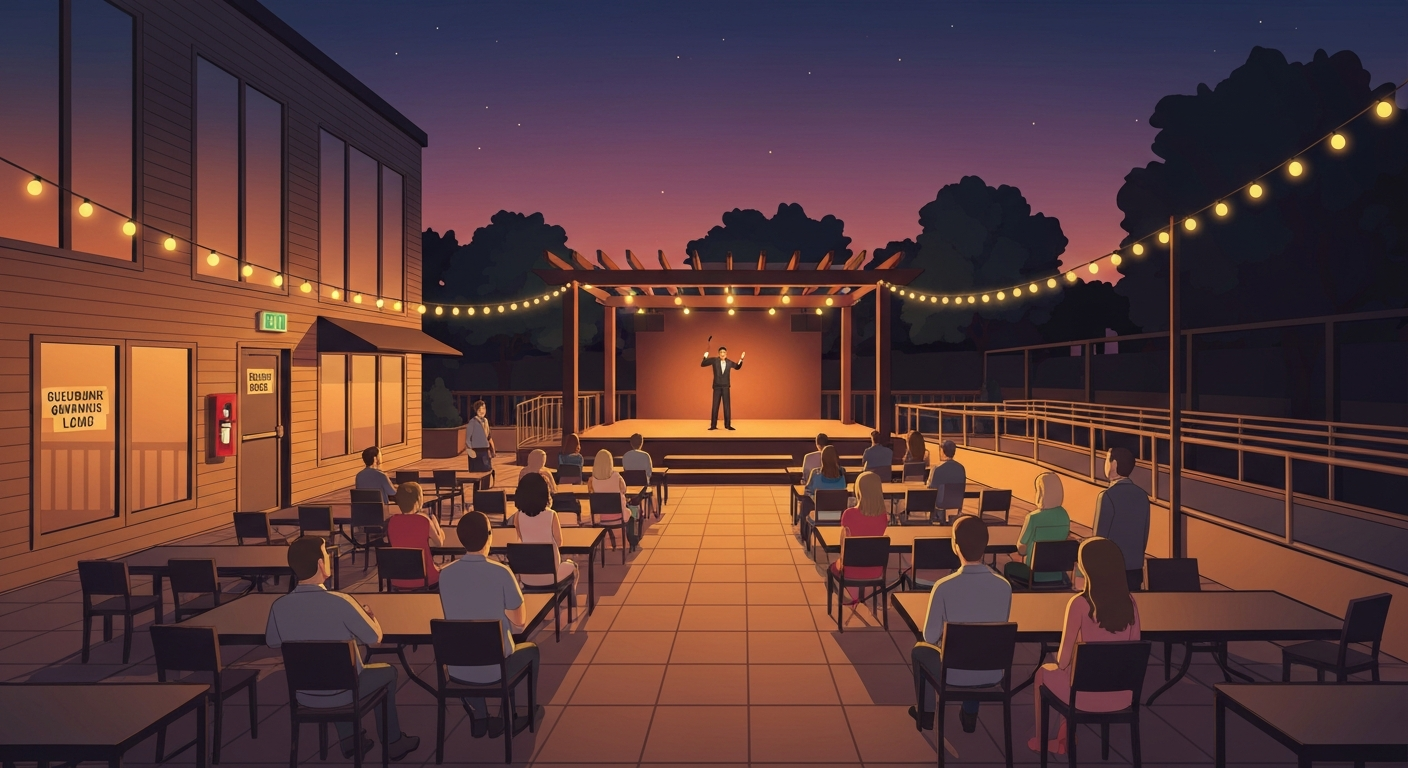
A patio theater (sometimes called an outdoor performance patio) is an open-air or semi-covered venue that combines dining or bar service with live entertainment. Think of a restaurant or bar that has converted its back patio, rooftop, or courtyard into a stage-and-seating setup. Layouts vary widely: some are fully open under the sky with string lights and folding chairs, others have permanent pergola covers, built-in stages, raised deck sections, and commercial sound rigs. Common uses include live music nights, comedy shows, film screenings, seasonal pop-ups, trivia events, and private event hire. What they share is that the same space used for drinks and dining is also handling a crowd gathered to watch or hear something, which adds an extra layer of occupancy and exit planning that a standard patio does not need to think about.
Structurally, patio theaters usually fall into one of three configurations: flat open courtyards with portable staging, elevated deck patios with a fixed performance corner, or covered semi-enclosed structures with partial walls. Each configuration carries its own safety profile, which is why a blanket answer of 'safe' or 'not safe' is less useful than knowing what to look for in any specific layout.
Judge a venue in under 3 minutes: a quick safety verdict framework
When you arrive at any patio theater, you can form a reliable safety read surprisingly fast. Look for four things before you even sit down: a posted occupant load sign near the main entry or exit, at least two clearly marked and unobstructed exit paths, furniture that does not wobble or tip when you brush it, and at least one uniformed staff member actively working the crowd rather than standing behind the bar. If all four are present, the venue is almost certainly operating with at least baseline code compliance and management awareness. If any of them are missing, that is a flag worth noting, though not automatically a dealbreaker.
- Find the occupant load sign: it should be posted conspicuously near the main exit or entry per the International Building Code. No sign visible anywhere? Ask a staff member what the posted capacity is.
- Count the exits: for an outdoor assembly area, the IBC requires means of egress that account for the full occupant load, including any people flowing through an adjacent indoor building. Two clear paths minimum is a reasonable rule of thumb for small venues.
- Do a 10-second furniture check: put your hand on a nearby chair or table and apply mild lateral pressure. Commercial-grade pieces should not shift or flex alarmingly.
- Spot a security or floor staff presence: industry staffing guidance commonly cites a range of roughly one security or steward per 75 to 250 attendees depending on risk level, with tighter ratios when alcohol is being served.
Every safety factor worth checking (the full list)
Patio theater safety breaks down into ten distinct categories. Each one can be a non-issue at a well-run venue or a real problem at a neglected one. Here they are in one place so you can work through them systematically.
- Structural integrity and patio furniture quality
- Crowd management, capacity control, and entry/exit flow
- Alcohol service and intoxication risk management
- Lighting levels, trip hazards, and nighttime visibility
- Weather preparedness: heat, rain, wind, and cold
- Sanitation, health, and ventilation for indoor-adjacent spaces
- Fire exits, emergency plans, and open-flame compliance
- Accessibility and child-safety considerations
- Parking lot and transit approach safety
- Staff training and on-site security protocols
Structural integrity and patio furniture: what to inspect and ask
The furniture at a patio theater takes more abuse than at a quiet brunch spot. Chairs get dragged, tables get leaned on, and crowded nights mean constant movement. Commercial-grade outdoor furniture should meet ASTM testing standards (ASTM F1561 covers structural performance for plastic outdoor chairs, for example) and the industry is moving toward the BIFMA OF-2025 outdoor furniture performance standard, which introduces accelerated-weathering and load testing specifically for commercial settings. What this means practically: if a venue is buying furniture that has been tested to recognized standards, it is rated for exactly the kind of repeated, heavy-use cycles a busy performance night creates. If they are using residential-grade pieces from a home improvement store, they are not. If you want an example of commercial-grade options for heavy-use outdoor venues, check the Grand Harbor May Street patio furniture collection for tested, weather-rated pieces designed for performance-patio settings.
Decking, railing, and elevated platforms deserve just as much attention. The IBC requires guard rails on elevated assembly areas to be at least 42 inches high. Stair riser heights should be no more than about 7 inches, and tread depths should be at least 11 inches for standard IBC assembly occupancy stairs. When those dimensions are off, trips and falls spike. Run your hand along any railing before an event: it should feel completely rigid, not flex or wobble at the post. For venues with rooftop patios, commercial anchoring or ballast systems for furniture and structures are standard practice to resist wind uplift, and ICC ESR documentation for patio structures spells out anchor spacing and load requirements. See ICC-ESR technical/installation guidance for patio/pergola products, which includes post, fastener, and anchor spacing and load specifications ICC-ESR technical/installation guidance for patio/pergola products (example: post/fastener and anchor spacing in ICC ESR documents). If a rooftop venue has unsecured umbrellas or freestanding heaters with no anchoring, that is a real concern on a breezy night.
Crowd management and capacity control
A well-run patio theater treats its posted capacity as a hard ceiling, not a soft suggestion. The IBC is explicit: outdoor areas used by the public require occupant load calculations, and when egress runs through an interior building, the load from both the outdoor space and the building must be combined in the calculation. In plain language, a venue cannot just pack the patio beyond its posted number because some of those people will be pushing through the bar to get out in an emergency. The Event Safety Alliance publishes operational guidance on crowd management and ingress and egress planning for exactly these kinds of live-event outdoor setups, and well-run venues typically have a floor plan that maps the entry and exit routes in advance.
What you want to see on-site: a clear entry checkpoint (even an informal one), visible signage marking exit routes, and a staff member or two whose actual job is working the floor rather than just serving drinks. If a venue looks wall-to-wall with no visible path to the exit, that is the single most acute safety concern on a busy performance night. Do not dismiss it as just crowded; at assembly occupancies, unmanaged overcrowding is how exits get blocked.
Alcohol service, ID checks, and intoxication risk
Most patio theaters serve alcohol, and that is not a problem in itself, but it does add specific responsibilities for the venue. Responsible service programs (RSA or TIPS training, depending on the region) are the baseline expectation for servers at any licensed outdoor venue. Practically, this means servers should be watching for signs of intoxication and cutting off service before someone becomes a hazard to themselves or others in a crowd. ID checks at entry are preferable to ID checks per drink on a busy night, since it is easier to manage at the gate than mid-service in a crowded patio.
For event planners, it is worth confirming whether the venue operates a last-call policy and whether they have a safe-exit plan: taxi/rideshare waiting areas, a sober-ride partnership, or at minimum a designated spot away from the parking lot for patrons to wait for a pickup. If you are exploring whether a specific patio actually does serve alcohol and what their service policies look like, that is a topic the Patio Restaurant Guide covers in its venue listings, including for named bars and patios across North America.
Lighting, trip hazards, and nighttime visibility
Evening performances on a patio are when lighting safety really matters. String lights and decorative fixtures are great for atmosphere but they are not a substitute for functional path and exit lighting. Outdoor electrical fixtures should be UL-listed for wet or damp locations per NEC and UL requirements, and any temporary wiring (extension cords, string lights for seasonal use) should meet UL 2438 or equivalent standards for outdoor seasonal use. Outdoor receptacles need GFCI protection under NEC 210.8(F) to protect patrons from electrical shock, particularly on surfaces that get wet from rain, spilled drinks, or morning dew. These are not obscure technicalities: they are the reason that a wet patio with an improperly installed power strip is a genuine hazard.
Beyond electrical safety, look at the physical path underfoot. Common trip hazards at patio theaters include: uneven pavers near the stage area, extension cord runs across pedestrian paths (even taped-down ones are a risk in low light), unmarked steps between deck levels, and pooling water near stage platforms after rain. If a venue goes dark between sets or during a film intermission, those hazards multiply fast. A well-run spot keeps path lighting on independently of the stage or screen lighting.
| Hazard | What to look for | Code/standard reference | Risk level if unaddressed |
|---|---|---|---|
| Unlit exit paths | Exit signs lit independently of decorative lights | IBC Chapter 10 / NFPA 101 | High |
| Wet outdoor receptacles without GFCI | GFCI outlets or breakers on all outdoor circuits | NEC 210.8(F) | High |
| Unsupported string lights / temp wiring | UL 2438-rated seasonal wiring, no cord runs on floor | UL 2438 | Moderate |
| Non-UL outdoor fixtures | Wet-location UL listing on all exposed luminaires | NEC / UL Solutions | Moderate |
| Uneven pavers or unmarked steps | Level surfaces, contrast markings on step edges | IBC stair geometry | Moderate |
| Low or missing guardrails on elevated decks | 42-inch minimum height, rigid posts | IBC 1015 guardrail requirements | High |
Weather preparedness: heat, rain, wind, and cold
Weather is probably the most underestimated safety factor at outdoor performance patios, and it is the one most likely to ruin an event or create a genuine emergency. A solid venue has a plan for each of the four main weather scenarios before the season starts, not improvised on the night.
Heat and sun
Summer afternoon shows can push heat into dangerous territory fast, particularly for older patrons or those who have been drinking. Look for shade structures, misting systems, and accessible water stations. A venue without any shade coverage during a mid-August afternoon performance is not set up for patron comfort or safety. Ask when you book: what is the sun coverage situation at 3 p.m. or 5 p.m. on a show day?
Rain and wind
Propane patio heaters and portable cooking equipment on the patio must comply with NFPA 1 and NFPA 58 (LP gas) requirements, which include defined clearances and often local fire-marshal permits. These rules exist because open-flame equipment in wind is a real fire and injury risk. For anchoring, commercial patio cover ESR reports (ICC technical documentation) specify anchor spacing and wind-load capacities for pergolas and cover structures. An unanchored tent or pergola on a rooftop patio in a windstorm is a serious hazard. Ask whether temporary structures at any outdoor venue have been permitted and inspected by the local fire marshal, especially for events where tents, canopies, or temporary stages are being added.
Cold weather and cancellation policy
Cold-weather events bring their own issues: propane heater placement, electrical load from added lighting and heating equipment, and icy or slippery surfaces on unprotected decks. A venue that runs fall and winter events should have a clear surface treatment protocol (salt, mats, anti-slip treatments) and a cancellation or postponement policy tied to defined weather thresholds, not just a vague 'weather permitting' note on the ticket. If you are planning a private event on a patio in October or November, ask for that policy in writing.
Fire exits, emergency planning, and open-flame compliance
NFPA 101 (the Life Safety Code) and the International Fire Code both apply to outdoor assembly occupancies, and their requirements scale with occupant load. At the permit level, the local fire marshal is usually the enforcement mechanism for temporary structures, tents, open-flame devices, LP-gas appliances, and commercial cooking equipment at outdoor events. Venues should have a posted emergency action plan and staff should know what it says. If you are planning an event rather than just attending one, ask the venue coordinator to walk you through the emergency plan: where patrons go, who calls 911, and what the designated assembly point is. That conversation takes two minutes and tells you whether the venue has thought it through.
Accessibility, child safety, and parking approach
ADA accessibility on outdoor patios can be inconsistent, particularly at older venues that added patio theater setups to existing structures without a full renovation. Check for level or ramped access between the entry point and the seating area, and confirm that accessible seating has clear sightlines to the stage. For families, elevated platforms, unfenced water features, and unguarded stair edges are the main hazards to scout on arrival. Parking lot safety matters more at evening events: confirm the lot is adequately lit, that the pedestrian path from the lot to the patio entry is clearly marked, and whether rideshare pickup has a designated spot that keeps vehicles away from the pedestrian entry.
Sanitation, ventilation, and health basics
The FDA Food Code has specific provisions for outdoor areas and temporary outdoor cooking operations (Section 6-102 and the 2022 Food Code outdoor cooking appendix), and state and local health departments enforce these at inspections. For patrons, the practical indicators are: whether food is being held at safe temperatures (no buffet items sitting unrefrigerated in summer heat for extended periods), whether handwashing stations are accessible in or near outdoor food-service areas, and whether trash is being managed actively during events so it does not attract pests. On the ventilation side, CDC and NIOSH guidance notes that outdoor spaces carry substantially lower airborne transmission risk than enclosed indoor ones, which is one genuine advantage of outdoor patios over enclosed venues. CDC/NIOSH notes that outdoor spaces have substantially lower airborne transmission risk than indoor spaces and recommends using outdoor settings when possible while maintaining spacing, ventilation for adjacent indoor areas, and cleaning protocols (Improving Air Circulation | Ventilation | CDC (NIOSH)). For indoor-adjacent spaces (covered areas with partial walls, indoor bars connected to outdoor patios), ASHRAE and CDC guidance on ventilation for those transitional zones still applies.
Visitor checklist: before you go, when you arrive, and after
Before you go
- Check the venue listing for posted capacity, permit status, and any recent inspection notes
- Confirm whether alcohol is served and what the service policy is (especially relevant for all-ages events)
- Check the weather forecast and ask about the venue's rain/cancellation policy
- Confirm accessible entry if needed and whether there is a dedicated rideshare pickup zone
- For private events: request the emergency action plan and fire-marshal permit documentation
When you arrive
- Locate at least two exit paths before you sit down
- Check for a posted occupant load sign near the main entry or exit
- Do a quick furniture stability check before settling in
- Note whether path and exit lighting is on independently of stage lighting
- Identify a staff member on the floor (not just behind the bar) who you can approach if there is an issue
On-site during the event
- Stay aware of crowd density near the stage: if the press of people is blocking your sight of an exit, move
- In hot weather, hydrate with water alongside any alcohol and use shade structures if available
- If temporary heaters are running, check that they are positioned away from seating and that there is clearance around them
- Report loose railings, exposed cords, or other hazards to a staff member immediately rather than waiting
What event planners should verify as minimum requirements
If you are booking a patio theater for a private event, the minimum documentation you should request from the venue coordinator before signing a contract covers the following.
| Requirement | What to ask for | Why it matters |
|---|---|---|
| Occupancy permit and posted capacity | Copy of the current occupancy certificate or posted load | Sets the legal cap on your guest count |
| Fire marshal permit for open-flame or tent structures | Permit number and inspection date for the current season | Confirms NFPA 1 / IFC compliance for heaters and canopies |
| Staff-to-attendee ratio | Confirmed security/steward count for your event size | Industry guidance: 1 per 75–250 depending on risk; tighter when alcohol is served |
| Emergency action plan | Written plan with assembly point, 911 contact protocol, and staff roles | Required for any assembly event under Event Safety Alliance guidance |
| Alcohol service policy | Server training certification (TIPS, RSA, or equivalent) and last-call policy | Reduces intoxication liability and guest safety risk |
| Weather cancellation policy | Written threshold (e.g., lightning within X miles, wind above Y mph) and refund terms | Protects guests and your deposit |
| Electrical safety documentation | Confirmation that outdoor circuits are GFCI-protected and fixtures are UL wet-location listed | NEC 210.8(F) and UL requirements for patron safety |
| Health department status | Most recent inspection result for outdoor food service | FDA Food Code outdoor area compliance |
How to use Patio Restaurant Guide to verify safety details
Patio Restaurant Guide listings include venue-specific details like hours, location, seating setup, and current promotions, which are useful starting points for confirming safety-relevant basics before you visit or book. For example, the Good Neighbor Bar patio is listed with detailed info on seating setup and hours, which can help you confirm safety-relevant basics before you visit. Listings for bars and entertainment patios often include whether alcohol is served and what the general vibe and crowd profile looks like, which ties directly into capacity and crowd-management expectations. If you are evaluating a specific named venue, the guide covers places like Broken City Patio, Good Neighbor Bar Patio, and Grand Harbor May Street patio furniture setups, and reader reviews often surface practical details about crowdedness, layout, and atmosphere that do not always make it onto a venue's own website. For anything that needs official confirmation (permit status, inspection records), those always require a direct call to the venue or a check with the local fire marshal or health department, but the guide gives you the informed baseline to know the right questions to ask.
Bottom line: patio theaters are a genuinely enjoyable format when the venue is doing its job, and the majority of well-established outdoor performance patios are. The safety factors are manageable and mostly visible on arrival. Use the framework in this guide, spend two minutes on your checklist when you get there, and you will have a clear read on whether a specific spot is worth staying at. If the exits are clear, the furniture is solid, the staff is present, and the weather plan exists, you are almost certainly fine.
FAQ
What is a 'patio theater' or outdoor performance patio?
A patio theater is an outdoor dining/entertainment area attached to or adjacent to a restaurant, bar, or venue where guests eat, drink and often watch live performances, film screenings, or speakers. It can be a fixed hardscape (paved patio, rooftop, deck) or a semi‑temporary event area (tents, stages, rented seating). Size and amenities vary widely—from small restaurant patios seating a few dozen to larger fenced event patios hosting hundreds.
Overall safety verdict: is the patio theater safe for casual diners, event planners, and patio enthusiasts?
Patio theaters can be safe when they meet basic building, fire and health standards and when the operator implements good crowd, alcohol and weather controls. Outdoor settings reduce airborne disease risk but introduce distinct hazards (trip/fall, weather, wind, heaters, temporary wiring, occupant‑load issues). Assess venue-specific evidence of compliance, staff training, and operational controls before deciding it’s safe for your needs.
What are the key safety factors to evaluate?
Structural/furniture integrity, means of egress and posted occupant load, crowd management and staffing, alcohol service and intoxication control, lighting and trip‑hazard management, weather/heat/cold/wind preparedness, sanitation and adjacent indoor ventilation, fire exits and emergency plans, accessibility and child safety, parking/transit safety, electrical safety (GFCI and listings), temporary structures and open‑flame permits, and security/staff protocols.
How do venues commonly mitigate these risks?
Common mitigations include: code‑compliant railings, anchored furniture, posted occupant loads and clear exit routes, staffed crowd management/security, trained bartenders and ID/over‑service policies, adequate lighting and taped cables or cord covers, heater and cooking permits with clearance, GFCI outdoor outlets and UL‑listed fixtures, posted emergency procedures and first‑aid plan, accessible routes and child‑safe barriers, and weather contingency plans (rescheduling, evacuation).
What evidence should I look for in a listing or confirm by phone?
Ask whether the patio has a posted occupant load, whether it has fire/permit inspections for heaters/cooking/tents, if outdoor outlets and fixtures are GFCI/wet‑location listed, what crowd‑management/security ratios are used, whether furniture is anchored or rated for commercial use, how emergency egress is handled, what the weather plan is, whether alcohol is served and what ID/sobriety procedures are in place, and whether staff are trained in first aid and emergency evacuation.
Visitor checklist — Before buying tickets or arriving
Check seating type (reserved/fixed vs loose chairs), confirm whether admission includes a pre‑assigned seat, review weather/cancellation policy, verify ADA access and restroom availability, ask about alcohol service and security, look for posted occupant load and emergency info on the venue website/listing, and read recent reviews for complaints about safety, overcrowding, lighting or staff responsiveness.