
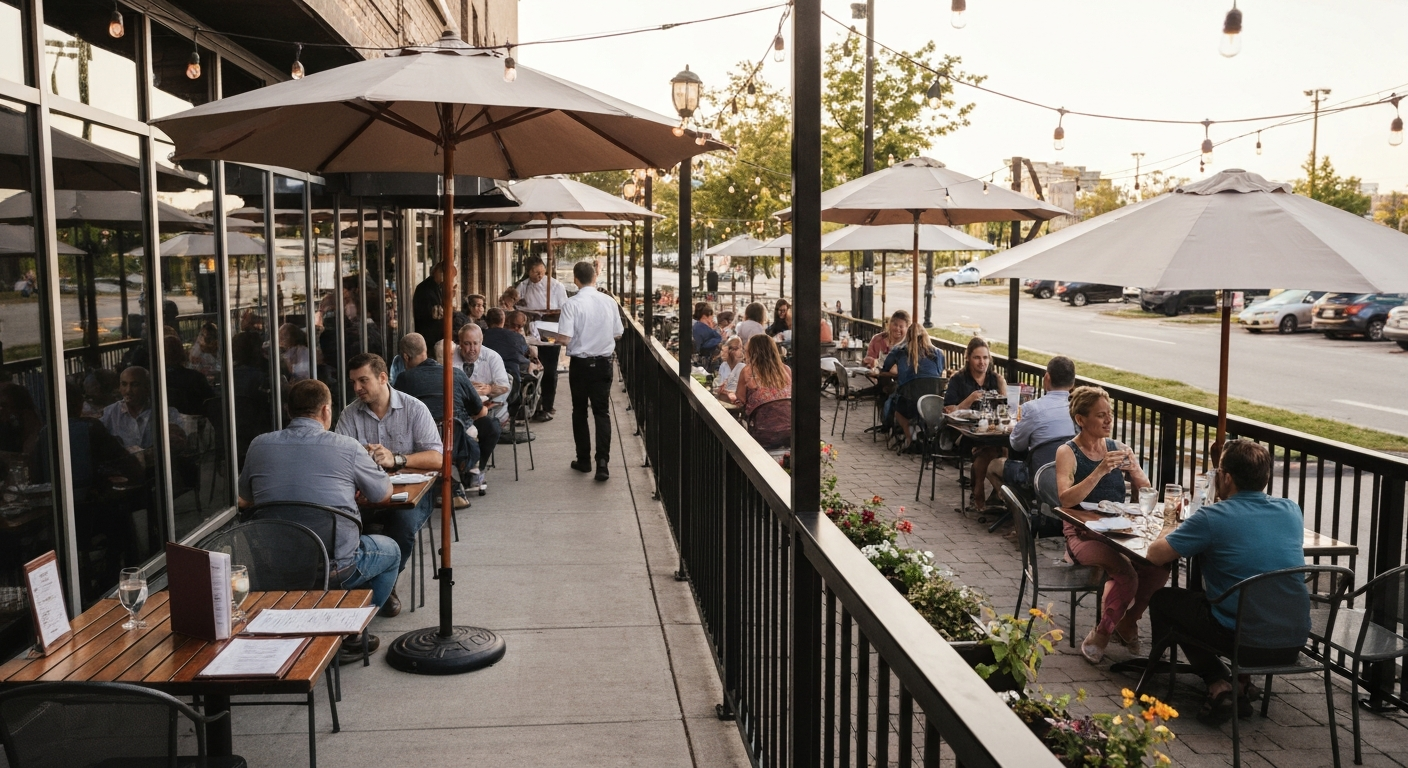
A patio restaurant is a dining venue that offers outdoor seating on a solid-surface area directly adjacent to the building, where guests can eat, drink, and socialize outside. The patio can be the main draw or a secondary seating area alongside an indoor dining room. Either way, the core idea is the same: food and drinks served in open air, typically on a ground-level concrete, stone, or paver surface. That's the Cambridge Dictionary definition in practical terms, and it's exactly what you'll find at thousands of venues across North America right now.
Patio Restaurant Meaning: Definition, Types & How to Find

Kira Carver
6 Aug 2026
Who actually uses patio restaurants (and why it matters)
Patio dining isn't just a nice-to-have. For a huge slice of North American diners, it's the whole point of going out. Casual diners want sunshine, fresh air, and a relaxed atmosphere that indoor tables can't always deliver. Families bring kids because a bit of noise isn't a problem outside. Pet owners specifically seek out patios because most health codes allow leashed dogs on uncovered outdoor areas, where food isn't prepared or stored. Event planners book patio spaces for birthdays, corporate happy hours, and rehearsal dinners precisely because the outdoor setting handles large groups naturally. And during the COVID-19 pandemic, the National Restaurant Association documented a significant surge in outdoor seating additions across the industry, which means today's patio scene is richer, more varied, and more intentional than it was even five years ago.
If you're planning anything from a solo Tuesday lunch to a 50-person Saturday event, knowing exactly what 'patio restaurant' means, and how different outdoor formats compare, helps you pick the right venue the first time.
Patio vs. terrace vs. rooftop vs. beer garden: what's actually different
These terms get used interchangeably in marketing copy, but they describe genuinely different setups. A patio is ground-level, attached to the building, and surfaced with a hard material like concrete, stone, or pavers. A terrace is typically an elevated outdoor platform, often accessed from an upper floor or built into a hillside, and it tends to carry a slightly more upscale connotation. A rooftop is exactly what it sounds like: dining on top of the building, which usually means city skyline views, a longer elevator ride, and more exposure to wind. A beer garden is a distinct tradition with German roots, characterized by communal picnic-style seating, gravel or packed-earth surfaces, trees for shade, and a focus on draft beer rather than full-service dining. Sidewalk seating, often called a sidewalk café, sits on the public sidewalk directly in front of the building and typically requires a municipal permit; cities like New York and Chicago have separate licensing and approval processes for these spaces. A parklet converts a parking lane into a small dining platform and operates under its own permit category in cities like San Francisco and Oakland. San Francisco’s Shared Spaces Design Guidelines (City and County of San Francisco) provide step‑by‑step design, insurance, and permit requirements for parklets and on‑street dining.
Side-by-side: patio types and what you can expect
| Format | Typical Location | Surface | Vibe | Common Amenities | Permit Usually Required |
|---|---|---|---|---|---|
| Patio | Ground-level, adjacent to building | Concrete, pavers, stone | Casual to upscale depending on venue | Heaters, string lights, umbrellas, planters | Sometimes (varies by city) |
| Terrace | Elevated, upper floor or hillside | Tile, wood decking, pavers | Upscale to mid-range | Railing, canopy, full bar service | Often (structural/building approval) |
| Rooftop | Top of building | Membrane deck, tile | Trendy, cocktail-focused | Fire pits, skyline views, DJ setup | Yes (building and liquor permits) |
| Beer Garden | Stand-alone courtyard or lot | Gravel, packed earth, grass | Communal, casual, family-friendly | Long tables, trees/shade, outdoor bar | Yes (liquor and zoning permits) |
| Sidewalk Café | Public sidewalk in front of building | Sidewalk/pavement | Urban, casual | Small tables, retractable awning, barriers | Yes (NYC, Chicago, etc. require specific licenses) |
| Parklet | Converted parking lane | Raised platform, wood or composite | Neighborhood casual | Planters, benches, bike racks nearby | Yes (DOT/city program approval) |
What you'll actually find on a patio: the physical setup
Patio setups vary a lot by climate, venue size, and budget, but there's a core set of features that define a well-run outdoor dining space. Here's what to look for when you're scoping a spot:
- Seating types: wrought iron or aluminum chairs, wood or teak furniture, bar-height tables, lounge sofas, picnic tables, or a mix
- Weather protection: retractable awnings, fixed pergolas, shade sails, large market umbrellas, or full enclosures with clear vinyl panels for shoulder-season use
- Heaters: freestanding propane tower heaters, wall-mounted electric infrared heaters, or overhead ceiling heaters; NFPA fire code guidance recommends maintaining clearances around portable propane units and shutting them off when the area is unoccupied
- Lighting: string lights (Edison bulbs are the go-to), pendant fixtures under a pergola, lanterns, LED uplighting in planters, or candles on tables
- Audio: outdoor-rated speakers, often a playlist rather than live music unless the venue has a dedicated stage
- Shade and greenery: natural tree canopy, tall planters with shrubs, living walls, or trellises with climbing plants that reduce direct sun and add visual privacy
- Surface and layout: smooth, ADA-accessible surface on the main path; accessible tables (knee clearance of 27 inches minimum) as required by federal ADA standards and confirmed by U.S. Access Board guidance on outdoor dining spaces
- Barriers and enclosures: low fences, rope dividers, or planter walls that define the patio from the street or parking lot
Operational details: services and policies worth checking
The physical setup is only half the picture. These operational factors make a real difference, especially if you're planning ahead or have specific needs: Under federal rules, businesses (including restaurants and outdoor dining areas) must allow service animals and staff may ask only limited questions, see Service Animals | ADA.gov.
- Pet policy: most municipalities allow leashed dogs in uncovered, non-food-prep outdoor areas; the ADA requires all businesses including restaurants to allow trained service animals in any dining area, indoors or out, and staff may only ask two specific questions per federal guidance at ADA.gov
- Accessibility: venues must provide an accessible route to outdoor seating under ADA standards; check in advance if raised platforms or steps are involved, since some older terraces and parklets may have limited access
- Restrooms: full patio dining should connect to indoor restrooms; for large ticketed outdoor events, look for whether the venue adds portable restrooms and confirm their location and number before booking
- Bar service: many patios operate a full outdoor bar; state alcohol rules vary (Washington State LCB, for example, requires licensees to get approval before extending outdoor liquor service), so some patios only allow drinks carried out from the indoor bar
- Reservations: popular patios fill fast on weekends and during summer; check whether the venue takes outdoor-specific reservations or operates first-come first-served
- Weather and cancellation policy: ask explicitly whether outdoor bookings move indoors during rain, whether the patio closes below a certain temperature, or whether deposits for private events are refundable for weather cancellations
- Dress code: patio restaurants skew casual, but rooftop and terrace venues sometimes enforce a dress code, especially after 9 p.m.
- Seasonal hours: many patios operate on a seasonal schedule, typically May through October in northern climates; always confirm current hours directly with the venue before making a trip
Booking a private event or group visit on a patio
Patios are genuinely one of the best formats for group events because the open layout handles noise and movement better than a cramped private dining room. If you're planning a birthday, team outing, or rehearsal dinner, here's how to approach it. Call or email the venue directly and ask whether the patio can be reserved as a semi-private or fully private space. Many venues require a food and beverage minimum rather than a flat rental fee. Ask for a site visit so you can confirm table configuration, speaker access, and whether an outdoor bar will be staffed for your group. For events over 30 or 40 people, confirm restroom capacity and whether portable facilities will be added. Get the weather policy in writing, including what happens to your deposit if the patio is unusable. If the venue serves alcohol outdoors, be aware that state liquor authority rules (like those from the NY State Liquor Authority or Washington State LCB) govern outdoor service areas, which can affect whether the full menu of drinks is available outside.
How to find a patio restaurant near you right now
The most direct route is a Google search or Google Maps query. For a quick location lookup, try the internal query 'where is the patio restaurant' to jump straight to a venue's exact address and map. Searching 'patio restaurants near me' or 'outdoor dining near [city name]' will surface both map pins and review snippets that usually mention outdoor seating. Try searching who has patio seating near me to pull up local review results and map listings. On Google Maps, filter by 'outdoor seating' under the attributes filter once you've run a restaurant search in your area. See our directory of today's patio locations for curated, up-to-date listings. Yelp has a dedicated 'outdoor seating' filter under the Features section. OpenTable and Resy let you search by date and often include seating preferences where you can specify outdoor.
If you're looking for a specific chain or recurring venue, named-location searches work well. Queries like 'Today's Patio near me' or 'today's patio locations' are popular for finding current-season venues that open and close on a seasonal schedule. Similarly, if you're searching for a specific named restaurant, try '[restaurant name] patio hours' or '[restaurant name] outdoor seating [city]' to pull up the most current information. If you need the address for a specific venue, try a named search like 'where is Grand Patio located' to pull up the current location and hours. For finding options in a neighborhood you're visiting, try 'who has patio seating near [neighborhood or intersection]' in Google, which often returns local review results alongside map listings. You can also try the query 'who does patios near me' to surface local venues; it's a useful variant for voice or casual searches.
- Google Maps: search 'outdoor dining [city]' then apply the Outdoor Seating attribute filter
- Yelp: use the Features filter and select 'Outdoor Seating' within your city or neighborhood
- OpenTable / Resy: enter your date and party size, then look for seating-preference options
- Google Search: try 'patio restaurants open now near me' or 'best patio [city] 2026' for current-season results
- Named-venue searches: 'Today's Patio near me', 'today's patio locations', or '[venue name] patio [city]'
- Direct venue website or social media: Instagram and Facebook often show current patio photos and seasonal opening announcements before they're updated on Google
One thing worth flagging: some search queries that include 'patio' are actually product searches, not restaurant searches. If you're seeing results for patio furniture brands, outdoor living retailers, or something like 'Patio Renaissance' (a furniture line), add the word 'restaurant' or 'dining' to your query to steer back toward venues. These product results show up because the word 'patio' pulls double duty in search. Refining your query gets you to the right results faster. If you were searching for the brand Patio Living, try a query like 'where is Patio Living located' or visit the brand's official site to find store locations and corporate contact information.
Verifying hours, promotions, and current conditions
Online listings for patio restaurants are notoriously stale. A Google Business Profile might show summer hours well into fall, or list a patio as open year-round when it actually closes in October. The safest approach is to check three sources: the restaurant's own website, their most recent Instagram post, and a quick phone call if you're making a special trip or bringing a group. For promotions like happy hour specials, live music nights, or patio pop-up events, the venue's social media is usually the fastest-updating channel. Seasonal promotions (summer cocktail menus, patio-opening weekend events) are often announced on Instagram or Facebook a few days before they go live.
A note on 'patio' product and brand searches
If you landed here looking for a specific patio brand, furniture line, or home improvement retailer rather than a restaurant, you're not alone. 'Patio' shows up in retail brand names, outdoor furniture product lines, and home-goods searches all the time. For retail product purchases like outdoor furniture sets, patio heaters, or brand-specific items, your best resources are the manufacturer's website, home improvement retailers (Home Depot, Lowe's, Canadian Tire for Canadian readers), or specialty outdoor-living stores. If you specifically want Patio Renaissance products, search "Patio Renaissance where to buy" on the manufacturer's site or major retailers to find current stockists. This site focuses specifically on patio dining venues and outdoor restaurant experiences, so for product purchasing guidance, those retail channels will serve you better.
FAQ
What core authoritative definitions and references should be cited when defining 'patio restaurant' for a North America–focused article?
Use a standard dictionary definition (e.g., Cambridge Dictionary for 'patio' as a solid‑floored outdoor area next to a building) plus restaurant‑industry guidance such as the National Restaurant Association’s outdoor‑dining best practices. Combine those with municipal program examples (NYC Sidewalk Café checklists, San Francisco Shared Spaces, Vancouver TEPP, Chicago outdoor‑dining code) to show how the term is used in practice and regulated locally.
Which municipal and regulatory sources are essential to explain permitting, design, and location differences (sidewalk, curbside/parklet, roadway, rooftop)?
Cite specific city program and code pages as examples because rules vary locally: NYC Sidewalk Café Checklist and Dining Out NYC guidance; Chicago Municipal Code for Outdoor Dining Street Permits; San Francisco Shared Spaces/Parklet Manual; Oakland/SF parklet program pages; Vancouver’s Temporary Expedited Patio Program. These illustrate the typical permit, design drawing, and insurance requirements and the differences among sidewalk cafés, parklets, and on‑street patios.
What safety and operational authorities should be referenced for heaters, propane, and general fire/CO safety?
Reference NFPA guidance on outdoor heater safety (NFPA 1/Outdoor Heater Safety fact sheet), the National Park Service guidance referencing NFPA 58 for LPG usage and clearances, and the U.S. Consumer Product Safety Commission (CPSC) guidance about carbon monoxide and portable heaters. These sources supply verifiable clearance, ventilation, and operational recommendations.
Which authorities cover accessibility and service‑animal policies for outdoor dining areas?
Use the U.S. Department of Justice (ADA) service‑animal Q&A for policy on animals in dining areas and the ADA/Access Board standards and guidance for accessible routes and outdoor‑dining design considerations. Where useful, cite state examples (e.g., Massachusetts accessibility guidance) to show local implementation of federal standards.
What sources are needed to explain alcohol service rules for patios and outdoor licensed areas?
Cite state and local liquor authorities and examples: Washington State Liquor and Cannabis Board guidance on outdoor alcohol service and city permit coordination, and New York State Liquor Authority materials explaining licensed outdoor areas. Emphasize that license and local municipal approvals are commonly required and rules differ by state/city.
What practical sources and methods should be recommended for verifying venue‑level details (hours, reservations, dress code, promotions, weather/cancellation policies)?
Advise checking the restaurant’s official website and social‑media pages, calling the venue directly, and cross‑checking reservation platforms (OpenTable, Resy), Google Business/Profile, and the venue’s listings on delivery or review sites. For permits or physical changes (e.g., permanent structures), consult the city permit portal or municipal GIS/records. Always note that front‑line verification (call/website) is required for current policies and hours.